The 13th Annual MSL Society Conference was held in Miami, Florida, from October 13–14, 2025, and included a workshop addressing career transitions for Medical Science Liaisons amid significant pharmaceutical workforce disruptions. With 128 layoff rounds reported in the first half of 2025—an increase of approximately 32 percent year over year (1)—the session provided practical frameworks for MSLs navigating career uncertainty. Thirteen MSLs and aspiring MSLs attended this interactive workshop, which emphasized peer-to-peer knowledge sharing, competency assessment, technological tools, cultural fit evaluation, and resilience strategies.
Session Framework and Approach
Tayo Fakunle opened the session by asking how many attendees had experienced job transitions. She clarified her approach: “I’m no expert—this isn’t a lecture; it’s a conversation we’re going to have together. I’m just a peer, a Medical Science Liaison in transition, just like some of you are.” Cherie Hyder, a senior leader with 35 years of experience in Medical Affairs, co-led the session with insights from decades of industry evolution. This dual perspective fostered both relatability and strategy, helping attendees frame career transition as a manageable and navigable professional phase rather than a setback.
The session addressed five key learning objectives: understanding Medical Affairs trends, conducting competency assessments, using innovative tools for job search and interviews, evaluating company culture through the Competing Values Framework (CVF), and building visibility during transitions.
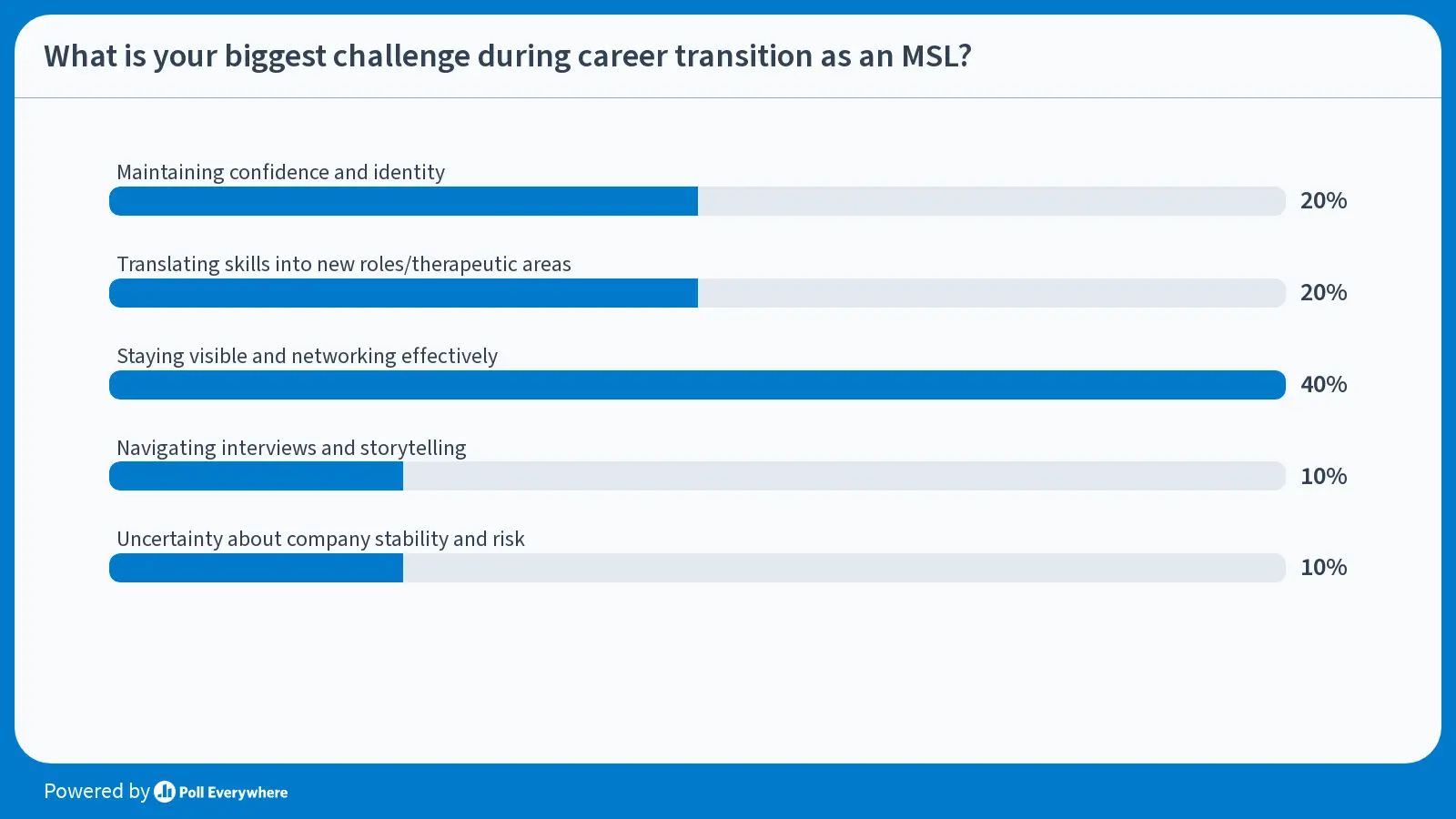
Before diving into content, a live Poll Everywhere activity allowed participants to share their transition challenges and career concerns anonymously. Responses highlighted themes of confidence loss, challenges transferring to new therapeutic areas, limited network visibility, and concerns about company stability during job searches.
Figure 1. Poll results from the workshop “Empowering MSLs in Transition: Strategy, Identity, and Tools for Reinvention” at the 13th Annual MSL Society Conference (Miami, October 2025).
Industry Context and Disruption Patterns
The discussion framed industry restructuring as structural rather than personal. Major companies—including Gilead, Bristol Myers Squibb, and Novo Nordisk—implemented broad reductions in 2025, while smaller biotechs faced 70–90 percent workforce cuts (2). Key disruption drivers included patent cliffs, clinical-trial failures, investor pressure, AI automation, limited venture funding, and portfolio consolidation. Participants were encouraged to reframe job loss from “I was let go” to “The system is evolving, and I’m evolving with it.” A case study illustrated warning signs of organizational instability: executive turnover, pipeline reprioritization toward late-stage assets, and budget freezes on approved projects. Participants were reminded that early recognition of such patterns enables proactive career planning. The workshop also reviewed Medical Affairs model evolution toward hybrid field structures, increased reliance on contract MSLs, and AI-enabled workflows. The idea of a “career lattice,” emphasizing lateral skill-building and adaptability, was presented as a modern replacement for traditional hierarchical career ladders.
Psychological Dimensions of Career Transition
The session acknowledged the emotional impact of job transition using the grief model—denial, anger, bargaining, depression, and acceptance—as a framework to normalize experiences. A four-step reinvention model was introduced: reflection (self-assessment), mindset shift (choosing growth over fear), action (rebuilding intentionally), and value proposition (recognizing enduring strengths). Tayo emphasized the importance of community and identity beyond company affiliation. She described the MSL Society as a stable professional home for all Medical Science Liaisons—employed or in transition—providing both emotional grounding and tangible professional support.
MSL Competency Framework
Cherie presented the MSL Competency Framework, which defines eight enduring competencies: relationship management, communication, leadership, evidence generation, business acumen, scientific expertise, technology fluency, and industry awareness. These competencies serve as anchors for career adaptability across company types and therapeutic areas. Following the overview, participants engaged in a discussion reflecting on how the MSL role is evolving, including changes in KOL expectations, leadership influence on medical strategy, evidence generation, value demonstration, and future competency priorities.
Technological Tools for Career Transition
The session also explored how AI-driven and bibliometric tools can serve as strategic assets for MSLs in transition (3–7). AI tools were discussed as iterative thinking partners for practicing interviews, summarizing publications, creating scientific narratives, and refining medical messaging. Bibliometric tools were highlighted for their ability to map key opinion leader networks, identify publication clusters, and track emerging trends. Many of these tools are freely available, allowing MSLs to continue scientific engagement and territory analysis without reliance on proprietary platforms while between roles.
Cultural Fit Assessment
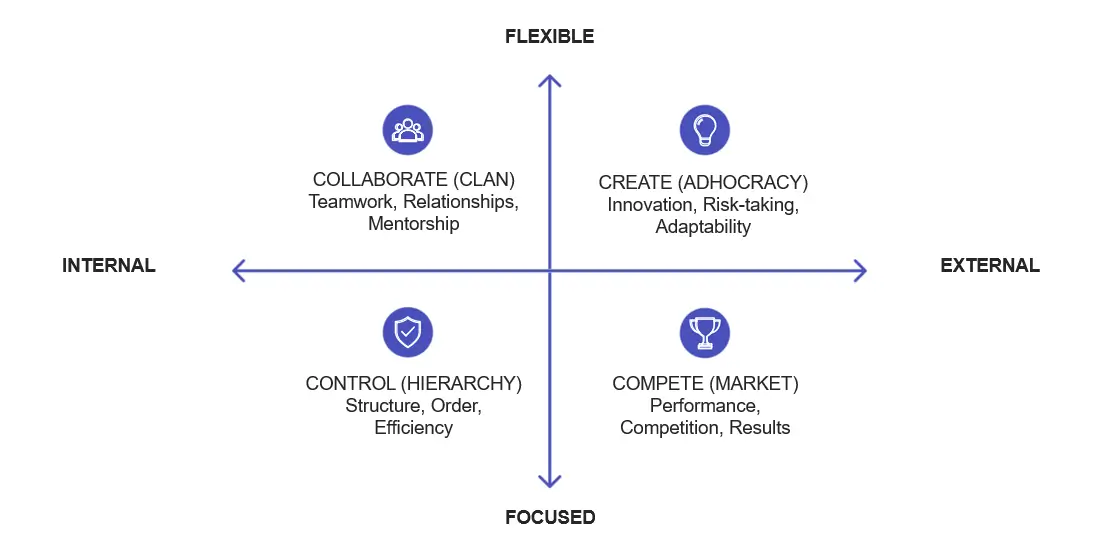
A model called the Competing Values Framework (CVF) was introduced to assess company culture and improve role alignment (8, 9). When attendees were asked if they were familiar with it, none raised their hands, showing its novelty for many MSLs. The CVF defines four culture types: Clan (collaboration and relationships), Adhocracy (innovation and risk-taking), Market (competition and results), and Hierarchy (structure and efficiency). Most organizations reflect aspects of all four, but one type typically dominates. Understanding these cultural profiles helps MSLs decide whether a company fits their natural work style—or where adaptation might be necessary. A reflective activity prompted attendees to evaluate past or current role satisfaction and identify alignment criteria for future roles.
Figure 2. The Competing Values Framework (CVF) illustrates four organizational culture types across two dimensions—flexibility vs. control and internal vs. external focus. Although most organizations reflect elements of all four quadrants (Collaborate, Create, Compete, Control), one typically dominates. Knowing the dominant quadrant helps MSLs assess cultural fit and adapt to succeed.
Risk Assessment, Visibility, and Resilience Strategies
The presenters shared practical guidance for assessing company risk when evaluating future opportunities, highlighting key indicators such as shifts in corporate culture or leadership, pipeline strength, investor activity, and the level of restructuring or single-asset dependency. Recognizing these patterns was emphasized as essential to making informed career decisions. Visibility was discussed as a strategic differentiator through maintaining a consistent professional presence on platforms like LinkedIn and expanding professional networks. Practical methods for sustaining professional and financial momentum included pursuing short-term MSL contracts, consulting, advisory roles, and medical writing opportunities. MSLs with clinical qualifications can pursue part-time clinical roles, such as per diem pharmacist or nursing positions, during transition periods.
Conclusion
The session reframed transition as an evolution rather than an interruption. Participants were encouraged to approach career change with structure, strategy, and community support. The closing message reinforced that Medical Affairs careers are nonlinear driven by adaptability, purpose, and lifelong learning.
Author Note
The use of generative AI supported the drafting of this conference proceeding.
References
(1) Fierce Biotech. “Biopharma layoffs in first half of year jump 32% YoY.” July 8, 2025. https://www.fiercebiotech.com/biotech/biopharma-layoffs-first-half-year-jump-32-yoy
(2) Biopharma Layoffs – 2025 Industry Summary. Sources include Fierce Biotech/Fierce Pharma layoffs tracker, California WARN database, and Reuters. https://www.fiercebiotech.com/biotech/biopharma-layoffs-first-half-year-jump-32-yoy
(3) van Eck N. J., Waltman L. “VOSviewer Manual.” Leiden University, 2023. https://www.vosviewer.com/documentation
(4) Donthu, Naveen, et al. “How to Conduct a Bibliometric Analysis: An Overview and Guidelines.” Journal of Business Research, vol. 133, 2021, pp. 285–296. https://doi.org/10.1016/j.jbusres.2021.04.070
(5) Harnessing Publicly Available Bibliometric Tools: Empowering Medical Science Liaisons. The MSL Journal. July 21, 2025. https://www.themsljournal.com/harnessing-publicly-available-bibliometric-tools-empowering-msls
(6) How MSL Candidates Can Use the Engineering Design Process and ChatGPT to Prepare for Clinical Paper Presentations. The MSL Journal. March 6, 2024. https://www.themsljournal.com/engineering-design-process-chatgpt-msl-presentations
(7) Cameron K. S., Quinn R. E. Diagnosing and Changing Organizational Culture: Based on the Competing Values Framework. 3rd ed. Jossey-Bass; 2011.
(8) How the Competing Values Framework (CVF) Can Help MSLs Understand Corporate Culture and Succeed. Medical Science Liaison Society Journal. July 12, 2024. https://www.themsls.org/journal/competing-values-framework-msl-culture-fit
About the authors:

Eyitayo (Tayo) Fakunle, PhD, MPH, MBA, MSL-BC
Tayo Fakunle is a Senior Medical Science Liaison with a career spanning the pharmaceutical, biotechnology, and medical device industries. She brings therapeutic experience across oncology, respiratory disease, allergy and immunology, orthopedics, cell therapy, and regenerative medicine. Tayo is committed to evidence-based scientific exchange, the generation of actionable medical insights, and building impactful partnerships with healthcare professionals and academic institutions. She is also passionate about professional development in Medical Affairs and advancing career resilience strategies for scientific professionals.

Cherie Hyder, PharmD, MSL-BC
Cherie Hyder is Senior Director of Medical Affairs Consulting at Syneos Health, where she supports strategic medical affairs capability building across therapeutic areas. With more than 35 years of industry experience, she has held leadership roles across drug development, medical strategy, and field medical excellence. Her career includes contributions at the U.S. Food and Drug Administration (CDER), Pfizer, Novartis, Eli Lilly, Avanir, Solvay, and Biohaven Pharmaceuticals, where she supported the virtual launch of Nurtec ODT. Cherie also serves as an adjunct faculty member and is recognized in the Medical Affairs community for her mentorship and leadership in MSL development.
Have an opinion on this article? Send a message to the editor.