And How it Will Set You Apart in an AI World
As an MSL before the advent of AI, you were the walking embodiment of scientific expertise. Your deep clinical knowledge, data interpretation, and peer-reviewed fluency were the currency of credibility.
But today? AI can analyze faster. Summarize better. Even anticipate questions before they’re asked.
So, where does that leave us?
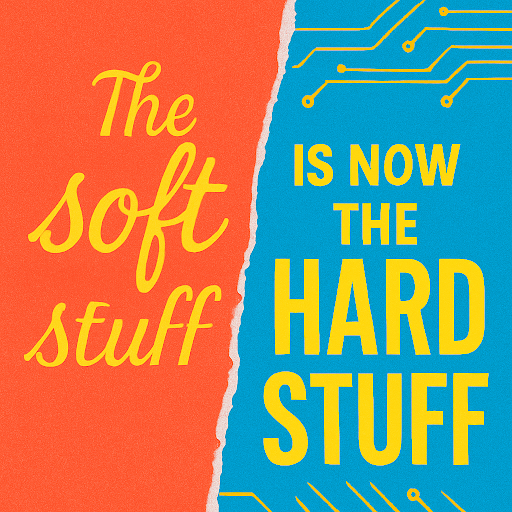
The irony is this: the skills once deemed “soft”— like trust-building, emotional intelligence, and strategic conversation are now the most important to master. When you’re looking to differentiate yourself, they are essential.
Why the Shift?
“AI will do the data. You need to do the trust.”
AI can already:
• Read and summarize clinical trial data in seconds.
• Generate slide decks.
• Track HCP preferences via engagement algorithms.
But it can’t:
• Build a trusted, human-to-human relationship with a skeptical KOL.
• Know the right moment to bring forward an insight.
• Align your scientific discussion to what truly matters to an HCP—and their patient
According to a global study of strategic account managers, the five most critical skills for next-level performance are all soft skills [1]:
- Communication
- Collaboration
- Strategic mindset
- Trust-building
- Internal influence
Recent data reinforces the shift: Wiley’s 2024 skill gap survey found 80% of professionals believe soft skills are growing in importance, and 84% still prefer face-to-face communication over AI-generated alternatives [2].
Forbes notes that while AI can out-analyze, humans can still out-lead, out-learn, and out-connect [3].
Fast Company calls soft skills like emotional intelligence and adaptability the “new currency of work” [4].
And Wired reminds us that in an AI-fueled workplace, the future will still be human-first [5].
Why These Skills Are So Hard
- They take time.
You can’t fast-track trust or download empathy. - They require unlearning.
You’ve been trained to deliver facts. That’s what got you through school, top of the class. Now, the new learning is around building trust so you can facilitate insightful conversations. - They’re invisible until they’re missing.
You can’t always measure a trusted HCP relationship. But when it’s gone? So is your influence.
Soft skills don’t show up on spreadsheets, but they determine the numbers that do.
What MSLs (and Their Leaders) Must Do Now
- Start with a mindset, not a method.
Belief precedes behavior. If you don’t believe your emotional and relational impact matters, you won’t develop it. The mindset of helping others, especially helping doctors help patients, will reconnect you to your deeper why. Purpose comes from serving others. And once you’re grounded in purpose, what you think, say, and do changes. That’s the mindset that leads to better outcomes. - Shift how we train.
The future isn’t more slide decks. It’s learning through story, reflection, and authentic dialogue. As an MSL team leader, it means creating space for MSLs to articulate their personal sense of purpose and to use that as a guidepost for more meaningful, patient-centered conversations. - Build emotional muscle like scientific muscle.
Just like we run journal clubs, we should run trust labs. Roleplaying with empathy. Rehearsing difficult conversations. Practicing vulnerably sharing your purpose story. Celebrating when connection made the difference. People with these muscles are the ones who have influence.
Want a simple framework for trust? Try the Trust Equation:
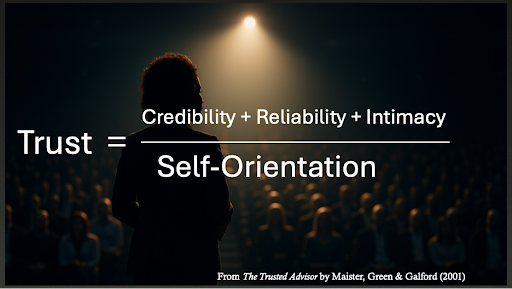
In your role as an MSL, you often focus on credibility, scientific accuracy, expertise, and of course, reliability (doing what you say you will), but trust is also about intimacy a (genuine, safe connection) and reducing self-orientation (patient-focused mindset). The best MSLs listen to understand and build connection and trust through purpose-led conversations. That’s what moves the trust dial.
Conclusion
You still have a powerful role to play in improving patient outcomes—but it won’t be just about delivering data. AI will carry some of that load.
The MSL of the future will win by:
• Inspiring belief.
• Cultivating trust.
• Helping HCPs feel something—connecting the science to something that matters—to the patient, the physician, the system.
And here’s the secret: that level of connection starts with you.
Purpose comes from service to others. Full stop. When you reconnect with your own purpose—when you remember that your role is to help doctors help patients—what you think, say, and do shifts. And you find your way to help, to make your impact, to make your difference in the world.
Purpose isn’t a soft concept. It’s a strategic one. It gives you clarity. It builds trust. And it sustains you when the metrics shift and the tech accelerates.
Because in the end, purpose drives performance.
And that’s something no machine can replicate.
That’s what makes the soft stuff the new hard edge.
Disclaimer: This article was developed with the assistance of generative AI tools.
References
- Boston Consulting Group & Strategic Account Management Association. Next-Level Strategic Account Management Skills: What It Takes to Win. BCG/SAMA Report, 2021.
- Wiley. Closing the Soft Skills Gap: Employers’ Perspectives on Human Skills in the Workplace. April 2024.
- Forbes. You Can’t Outcode AI, but You Can Outlead, Outlearn, and Outthink It. Jan 2025.
- Fast Company. The Soft Skills That Matter Most in 2024—and Beyond. Sept 2024.
- Wired. The AI-Fueled Future of Work Needs Humans More Than Ever. 2023.
- Maister, D.H., Green, C.H., & Galford, R.M. The Trusted Advisor. Free Press, 2001.
About the author:

Jill Donahue, MadEd, HBa
When Jill was 35, her father’s life was tragically lost due to an avoidable prescribing error. Working in pharma, she was driven to figure out how we could do better. Her research revealed one crucial insight: purpose transforms outcomes.
Through her 3 books, programs, and speaking engagements, she empowers pharma leaders to build trust, foster collaboration, and achieve
Have an opinion on this article? Send a message to the editor.