“Ladies and gentlemen, the animal health market has exploded”.
Over the past few decades, the animal health industry has undergone a profound transformation, particularly within the companion animal segment. In developed countries, the strengthening of the animal-human bond has resulted in increased attention to animal welfare and a growing willingness of pet owners to invest in veterinary care. This societal shift has translated into sustained expansion of the animal health market. Recent analyses estimate the global animal health market at approximately USD 68.6 billion in 2024 and project it to reach more than USD 162 billion by 2035, with a compound annual growth rate of around 8%1.
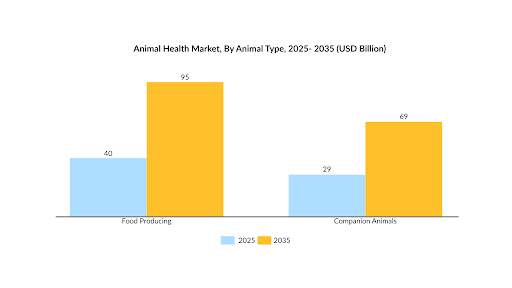
Within this landscape, companion animals represent one of the fastest-growing segments. Increasing pet ownership, the humanization of pets, and greater awareness of preventive veterinary medicine are among the key drivers behind this growth.
Parallel to this market expansion, the scientific landscape of veterinary medicine has evolved considerably. Veterinary pharmaceutical portfolio is increasingly benefiting from drug development originally carried out in human medicine. New biotechnological therapies, including monoclonal antibodies, DNA vaccines or recombinant proteins are reshaping the veterinary medicine paradigm, forcing companies to adapt their internal structures, strengthen their scientific capabilities, and develop new specialized roles in order to remain competitive in an increasingly complex and innovation-driven market.
In response to this growing complexity, animal health companies have gradually adapted their organizational structures. However, rather than establishing fully independent scientific functions, the veterinary industry has often relied on hybrid roles intended to bridge the gap between scientific knowledge and commercial activities. These positions typically operate within marketing or sales departments and combine elements of commercial responsibilities with a higher-than-average level of technical expertise.
While these hybrid roles have provided a pragmatic solution for companies facing increasingly complex products, they remain embedded within commercial teams, often prioritizing product support and promotional objectives rather than independent scientific exchange. Consequently, they do not fully address the need for a dedicated scientific interface between pharmaceutical companies and the veterinary community.
In the human pharmaceutical industry, this demand has long been met by Medical Science Liaisons (MSLs). However, veterinary companies seeking to introduce this pioneering role face significant challenges. With few precedents to follow, they can either copy the MSL job description from human pharma or look to other animal health companies for guidance. Both approaches have significant limitations: the first may not align with the specific needs of the veterinary field, and the second offers little direction, as most companies still rely on hybrid roles. As a result, many struggle to define a dedicated scientific position that truly acts as an interface between industry and the veterinary community.
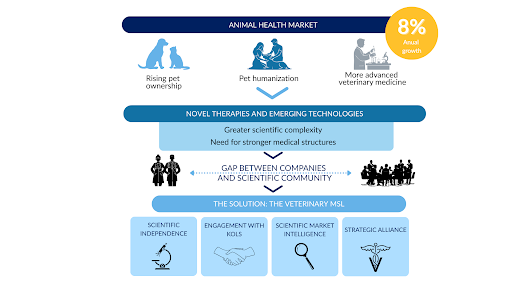
In line with this, scarcely any animal health departments within the pharmaceutical industry are currently considering the incorporation of the veterinary MSL role into their teams. This reality underscores, with complete clarity, the urgent need to enhance the visibility and recognition of the strategic value that MSLs bring to Medical Affairs. Only by doing so will companies be compelled to transform their internal structures to integrate this essential player. In other words, it is crucial to convince internal decision-makers that the veterinary MSL is a professional figure that they can no longer afford to ignore. For this purpose, it is strongly recommended to present robust, evidence‑based arguments that clearly demonstrate why the MSL has become a critical scientific function within Medical Affairs, arguments that organisations must fully embrace, namely:
- The veterinary MSL represents a scientifically independent player whose operational autonomy from Marketing and Sales triggers genuine trust among KOLs, who gradually come to recognize the absence of promotional bias and regard them as a credible and neutral scientific reference, mainly committed to evidence and scientific rigor.
- Such independence enables the MSL to set up a direct and worthwhile bidirectional channel of communication, acting as the cornerstone that helps bridge the gap between corporate objectives and the unmet needs of the scientific community. Consequently, companies can operate with greater clarity in an increasingly competitive environment.
- Through periodic updates that tackle strictly scientific insights, such as participation in studies, support with publications and deep face‑to‑face scientific discussions, the MSL becomes the preferred reference contact for KOLs. Experts rely on them as a trustworthy source of information on company products with the capacity to address specific questions in the therapeutic area, share recent publications, support the interpretation of newly generated evidence and even collaborate as a connector for potential research partnerships or clinical field studies.
- From the corporate side, the continuous presence of the veterinary MSL in the field allows them to assess the real world of veterinary practice and its scientific dynamics, as well as competitor activities and emerging trends. All these elements collectively provide a whole picture of the market and its short‑ to mid‑term direction. These insights could help the company make strategic decisions with precision, anticipate challenges, identify potential risks and define evidence‑based, well‑aligned strategic plans capable of generating new opportunities that yield a competitive advantage in a fast‑evolving and increasingly saturated market environment.
- Ultimately, the veterinary MSL embodies a transversal, trustworthy and opportunity‑generating function. This strategic ally not only represents a visible reference of scientific consistency within the company but also acts as the relational anchor for external experts and the internal engine of strategic intelligence. This unique combination strengthens the capability of the organization to manage critical scientific challenges and reinforces the competitive advantages that could shape its long‑term positioning in the animal health sector.
In a nutshell, the first steps should get to the core of the issue: underscoring the compelling value that the MSL role can offer to the veterinary pharmaceutical industry. As a first meaningful step toward that objective, collaborative hybrid activities must be promoted, taking advantage of both the robust, nearly 60‑year experience initiated in 1967 within human Medical Affairs2 and the know-how of professionals in the veterinary pharmaceutical industry and KOLs across the animal health sector. The setting up of these synergetic initiatives with experts representing two sides of the same coin would foster the development of a baseline consensus document that the veterinary pharmaceutical industry could use as a reference when it is willing to move forward, leave its comfort zone and include this core, stakeholder‑facing function within Veterinary Medical Affairs organizational structure.
It is time for the veterinary sector to take the plunge and bet on this dark horse if it really wants to avoid being left behind in this race to conquer the veterinary market!
REFERENCES
- Market Research Future. Animal Health Market Size, Share, Trends Forecast 2035. Market Research Future. Available at: https://www.marketresearchfuture.com/reports/animal-health-market-7163
- The MSL Society. What is a Medical Science Liaison (MSL). The MSL Society. Available at: https://themsls.org/what-is-an-msl/
About the authors:

Ruben Foj Ibars, MSc
Rubén Foj Ibars graduated in Biotechnology from the Autonomous University of Barcelona (UAB) and completed a master’s degree in the Pharmaceutical and Biotechnological Industry at Pompeu Fabra University. In 2015, he joined LETI Pharma in the Animal Health Unit as an R&D Specialist in the field of Leishmania, and in 2022 he became part of the Veterinary Medical Affairs Department as an International Medical Scientific Liaison.
He is also a part‑time Associate Professor at UAB in the Department of Pharmacology, Therapeutics and Toxicology, teaching Pharmacology with a focus on immunomodulatory agents and system‑specific therapeutics.
Over the past 15 years, he has contributed to and presented several scientific communications at international conferences, as well as in indexed peer‑reviewed journals.

Sara Corral Martín, DVM, MSc
Sara is an MSL in Veterinary Medicine at LETI Pharma. She graduated in Veterinary Medicine at Complutense University of Madrid and obtained an MSc in Advanced Immunology at University of Barcelona and Autonomous University of Barcelona. She joined LETI Pharma in 2024 as an MSL in veterinary dermatology and leishmaniosis.
Together, they are shaping a pioneering and often under-recognized role in the veterinary industry. With few precedents to follow, they are tailoring the MSL function to the real-world of veterinary medicine, building practical frameworks and educational standards while bridging the gap between science and clinical practice. They contribute to the life-cycle management of a recombinant vaccine against canine leishmaniosis and to raise awareness about this parasitic disease all over Europe.
Have an opinion on this article? Send a message to the editor.