Technological advancements are rapidly transforming the pharmaceutical industry, and the role requirement of the Medical Science Liaison (MSL) is also being transformed at the same promptness. As the pharmaceutical landscape shifts, technologies such as artificial intelligence (AI), digital health tools, and data analytics are having a profound impact on how MSLs engage with key opinion leaders (KOLs) and healthcare professionals (HCPs) (Ng & Zhang, 2023). This article explores these emerging technologies and offers actionable strategies for MSLs to enhance their effectiveness and career prospects by embracing these innovations.
The Technological Landscape
Emerging technologies such as AI, digital health tools, and advanced data analytics are reshaping the pharmaceutical industry. These innovations are enabling MSLs to interpret data more effectively, engage with healthcare professionals more efficiently, and drive informed and evidence-based decisions.
- AI: AI and machine learning are revolutionizing pharmaceutical research by analyzing complex datasets with remarkable speed and precision. AI-driven tools are being used to predict drug efficacy and identify potential safety concerns before clinical trials even begin (Obermeyer et al., 2016). For MSLs, this presents a valuable opportunity to enhance interactions with KOLs by providing precise and data-driven insights. AI-generated predictions can be used to anticipate the needs of KOLs and HCPs, enabling MSLs to offer relevant and timely data that supports clinical decision-making.
- Digital Health Tools: Wearable technology and mobile health applications are increasingly being integrated into patient management, offering real-time data on patient adherence and treatment outcomes. These tools provide real-world evidence that can be leveraged by MSLs to personalize discussions with KOLs and HCPs. For example, data from wearable devices can offer insights into patient behavior, providing a more comprehensive view of treatment effectiveness and patient adherence (Banaee et al., 2013). This enables MSLs to provide more meaningful and patient-centric interactions, thereby enhancing the quality of engagement with HCPs.
- Data Analytics: Advanced data analytics platforms allow MSLs to process large volumes of clinical data to uncover trends and patterns that can inform medical strategies. Predictive analytics, for instance, have proven valuable in identifying potential research areas and shaping strategic planning (Wang et al., 2016). MSLs who are proficient in data analytics can provide more targeted insights to KOLs and HCPs, aligning medical strategies with emerging trends and market needs. This not only enhances the value of MSLs in the eyes of HCPs but also strengthens their role as strategic partners within their organizations.
Shaping the Future: How MSLs Can Thrive with Emerging Technologies?

Figure 1. Key strategies for MSLs to embrace emerging technologies and drive professional transformation.
- Enhanced Data-Driven Decision-Making: AI and data analytics are enabling MSLs to provide KOLs and HCPs with deeper insights based on real-time and evidence-based data. AI tools can streamline the process of reviewing complex medical data, allowing MSLs to respond to inquiries from healthcare professionals with greater speed and accuracy (Topol, 2019). This improves the efficiency of information delivery and positions MSLs as reliable and knowledgeable resources for clinical decision-making.
- Personalized Engagement: Data from digital health tools, such as wearables and mobile health applications, allows MSLs to engage in more individualized, patient-centric conversations with KOLs and HCPs. For instance, real-time data on treatment adherence and patient outcomes can enhance discussions, providing KOLs with a more nuanced understanding of treatment effectiveness. This personalized approach helps build stronger relationships and adds value to the interactions between MSLs and healthcare professionals (Steinhubl et al., 2015).
- Continuous Learning: Embracing these technologies requires MSLs to continually update their knowledge and skills. Staying informed about the latest advancements in AI, digital health tools, and data analytics is essential for MSLs to remain competitive and effective in their roles. Regular participation in workshops, conferences, and online courses focused on emerging technologies can help MSLs stay ahead of industry trends and ensure they are fully equipped to integrate these tools into their day-to-day responsibilities (Banaee et al., 2013; Kvedar et al., 2014).
- Improved Data Literacy: Proficiency in data analytics is essential for MSLs who aim to provide strategic insights and support evidence-based decision-making. Developing strong skills in data interpretation and analysis allows MSLs to offer more targeted and relevant insights to KOLs and HCPs (Wang et al., 2016).
- Adapted Communication Strategies: As the pharmaceutical industry increasingly adopts digital engagement methods, MSLs must adapt their communication strategies accordingly. Mastering virtual meeting platforms and incorporating real-world data into discussions with KOLs and HCPs can elevate the quality of engagement. This digital-first approach will become an essential skill for MSLs as they continue to interact with healthcare professionals in an increasingly virtual environment (Zhao et al., 2020).
- Collaboration with Internal Teams: Collaboration with internal teams, including data scientists and IT specialists, can help MSLs integrate technological tools more effectively into their workflows. This collaborative approach is essential for ensuring that AI, digital health tools, and data analytics are utilized to their full potential in enhancing MSL effectiveness (Kvedar et al., 2014).
Conclusion
Emerging technologies such as AI, digital health tools, and data analytics are transforming the MSL profession. These innovations offer MSLs the opportunity to provide deeper insights, more personalized interactions, and greater value to KOLs and HCPs. However, the successful integration of these technologies requires continuous learning and adaptation. By embracing these advancements and adopting new strategies for engagement, MSLs will be well-positioned to enhance their effectiveness, advance their careers, and contribute to the success of their organizations.
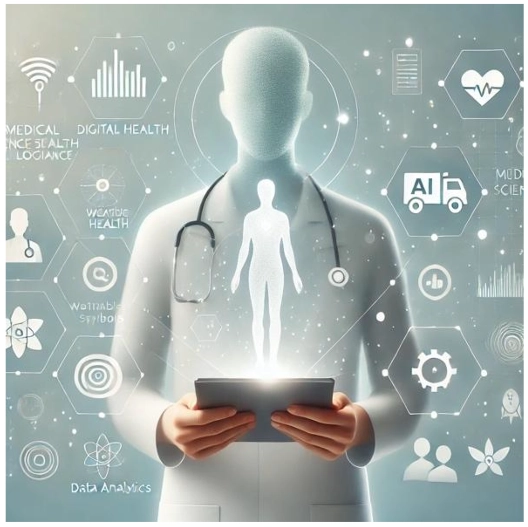
Figure 2. Representation of the MSL role interacting with emerging technologies. It features minimalistic elements, focusing on the core themes of AI, digital health, and data analytics. Created by ChatGPT-4o model.
References
- Banaee, H., Ahmed, M. U., & Loutfi, A. (2013). Deep learning for health informatics. IEEE Transactions on Biomedical Engineering, 60(10), 2931-2937.
- Kvedar, J. C., Fogel, A. L., & Elenbaas, R. (2014). The role of technology in shaping the future of healthcare. Journal of Medical Internet Research, 16(8), e169.
- Obermeyer, Z., Powers, B., Vogeli, C., & Mullainathan, S. (2016). Dissecting racial bias in an algorithm used to manage the health of populations. Science, 366(6464), 447-453.
- Ng, K. K. Y., & Zhang, P. C. (2023). Advancing medical affair capabilities and insight generation through machine learning techniques. Journal of Pharmaceutical Policy and Practice, 16(1), 165.
- Steinhubl, S. R., Muse, E. D., & Topol, E. J. (2015). The digital revolution in cardiology. Journal of the American College of Cardiology, 65(4), 353-355.
- Topol, E. J. (2019). Deep medicine: How artificial intelligence can make healthcare human again. Basic Books.
- Wang, F., Casalino, L. P., & Khullar, D. (2016). The role of data analytics in healthcare transformation. Health Affairs, 35(3), 486-491.
- Zhao, Y., Li, Q., & Jiang, M. (2020). Telemedicine in the era of COVID-19: Current status and future prospects. The Lancet Digital Health, 2(6), e283-e289.
About the author:

Sandra F. Gomes
Sandra F. Gomes is a PhD Candidate in Experimental and Clinical Pharmacology and Toxicology at the Faculty of Medicine, University of Porto (FMUP), Center for Drug Discovery and Innovative Medicines (MedInUP), and RISE-Health, in Portugal.
With over a decade of postgraduate experience in Clinical, Biomedical, and Academic Research, her expertise includes Pharmacology, Immunology, Translational Medicine, and Drug Discovery, focused on managing clinical studies and leading biomedical projects. Sandra has contributed extensively to research in Inflammatory Bowel Disease (IBD), utilizing both preclinical in vitro and in vivo models and patient-based studies. She is passionate about bridging the gap between research and clinical applications, translating complex findings into actionable insights. Additionally, Sandra has led educational initiatives, mentoring students and developing innovative courses on Research Ethics, Academic Integrity, and Scientific Methodology. With a strong foundation in scientific communication, her work aims to advance healthcare and improve patient outcomes globally.
Have an opinion on this article? Send a message to the editor.