Medical Affairs is moving from “science conduit” to decision partner – a role that asks Medical Science Liaisons (MSLs) to spot real-world signals, turn them into timely actions, and explain numbers so clinicians and patients actually change what they do next (1,2). The good news: you do not need a data lake or a PhD in artificial intelligence (AI) to start; what you need is a disciplined way to rate insights, a lightweight dashboard to close the loop, clear number-communication habits, and a few AI-assisted workflows that save time without risking compliance – because organizations capture value when they rewire workflows, not when they add point tools (3).
What the evidence says about measuring MSL impact
Across a global sample of 1,023 medical affairs professionals, teams still default to counting interactions (92 %) even though respondents prefer qualitative, impact-oriented metrics; only 3% rate their current key performance indicator (KPI) sets as “very effective,” which is precisely why we should track insight-to-action and time-to-action instead of raw activity (4). A national survey of Canadian Medical leaders echoes the point: healthcare professionals (HCP) feedback, the quality of insights, and even interaction length (as a proxy for depth) are judged more useful than volume counts, yet they are tracked less consistently; leaders also anticipate more digital engagement and want metrics that reflect that reality (5,6). The core message is simple: measure outcomes and learning, not just activity (7).
Make insights decision-ready
Treat every field note as a testable hypothesis that either triggers an action or gets archived. A practical scorecard keeps teams aligned: Is it new for the therapeutic area (TA)/brand? Will it trigger a concrete action within 90 days? Is it on strategy (evidence, engagement, access)? Is it well-grounded in auditable data (trials, real-world evidence (RWE), guidelines)? And how fast can we move from capture to implementation? Insights that score highly should convert into actions – content refreshes, advisory boards, targeted education, or evidence plans – and we should track that conversion over time, because these are the qualitative outcomes leaders say actually demonstrate value (4,5).
Close the loop with a light dashboard
You do not need enterprise business intelligence (BI) to see what matters. A single-page view – in Power BI, Tableau or Looker – should answer three questions: what are we seeing, what changed because of it, and how fast did we act. In practice, that means a live pipeline of insights by theme and status; a view that shows quality versus volume so “interesting” does not crowd out “useful”; and a conversion panel showing the share of insights that triggered actions and the median time-to-action. Share this routinely with Medical leadership; impact narratives beat raw counts – indeed, Canadian leaders report that dashboards gain value when they reflect insight quality and downstream outcomes, not just interactions (6,7).
Use AI where it genuinely helps
The cleanest early win is in medical information (MI) and congress follow-up, where AI can cluster similar questions, surface trends, and standardize responses without inventing facts. One open-access implementation – MUFASA – turns free-text MI cases into vectors, runs semantic search, tracks topic frequencies over time, and clusters themes. Teams reported faster case handling, better onboarding, improved response consistency, and lower compliance risk. In plain terms: you can spot a sudden uptick in stability questions after a pack-size change, then route a targeted asset to the right HCPs (7). These gains came with observability (who did what, when) and human checkpoints for judgment calls – showing that AI adds value when embedded in a governed workflow, not pasted onto old steps (8,9).
Respect the red lines
The Japan experience is a crisp reminder that medical must be independent of sales, with scientific exchange and evidence generation anchored in patient benefit, not promotion. After high-profile compliance failures, companies formalized the separation of medical affairs, clarified non-promotional roles, and prioritized visible trust-building with key opinion leaders (KOLs) and regulators; your processes, dashboards, and AI tools should reflect that independence and leave an audit trail (10).
Speak numbers people can act on
How we present data changes decisions: lead with absolute risks and fixed denominators (per 100 or per 1000), not “1-in-X” or relative risks without context; pair percentages with part-to-whole visuals (icon arrays; stacked bars) (Figure 1). For biomarkers, add thresholds and the minimal clinically important difference so “what now?” is obvious. These small choices improve comprehension and trust in shared decision-making (2).
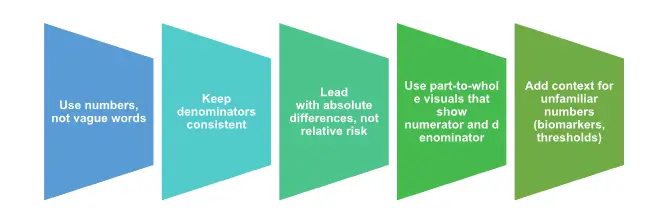
Figure 1. Five main recommendations for communicating medical numbers.
Practical steps you can implement
Tag the next 90 days of incoming insights with a simple quality rubric and link each item to a concrete action – or a documented reason for “no action.” Publish a one-page dashboard that shows pipeline, quality vs. volume, and conversion. Re-map one high-friction workflow – for example, congress debrief to content update – so repetitive steps are automated (search, clustering, templated summaries) and human checkpoints are explicit (8). Finally, refresh key slides and medical letters using the number-communication rules above; pilot one “snackable” visual per message with two HCPs before you scale – this better reflects what leaders actually want to see in metrics: insight quality, clearer HCP feedback loops, and faster time-to-action rather than bigger activity counts (5,6).
Why does this approach travel with you
Whether you are new in role or a seasoned MSL, the combination of a quality-first insight habit, a tiny-but-useful dashboard, AI-assisted pattern finding, and clear number framing works across brands, countries, and lifecycle stages. It aligns with how leaders already judge value (qualitative outcomes and learning) and with where Medical Affairs is heading next – more digital, more analytics, and tighter governance (1). It also fits the profession’s north star: field medical as a trusted, non-promotional engine for evidence and decisions (11).
References
- Algazy J, Garcia A, Ryan S, Westra A, Zemp A. A vision for medical affairs 2030: Five priorities for patient impact[Internet]. McKinsey & Company; 2023 Oct 11 [cited 2025 Sep 28]. Available from: https://www.mckinsey.com/industries/life-sciences/our-insights/a-vision-for-medical-affairs-2030-five-priorities-for-patient-impact
- Zikmund-Fisher BJ, Thorpe A, Fagerlin A. How to Communicate Medical Numbers. JAMA [Internet]. 24 de setembro de 2025 [citado 28 de setembro de 2025]; Disponível em: https://jamanetwork.com/journals/jama/fullarticle/2839303
- Singla A, Sukharevsky A, Yee L, Chui M, Hall B. The state of AI: How organizations are rewiring to capture value[Internet]. McKinsey & Company; 2025 Mar 12 [cited 2025 Sep 28]. Available from: https://www.mckinsey.com/~/media/mckinsey/business%20functions/quantumblack/our%20insights/the%20state%20of%20ai/2025/the-state-of-ai-how-organizations-are-rewiring-to-capture-value_final.pdf
- Dyer S, Hyder C, Kraemer J. Challenges of Key Performance Indicators and Metrics for Measuring Medical Science Liaison Performance: Insights from a Global Survey. Pharmacy. 2 de abril de 2025;13(2):51.
- Theron P, Britland M, Holder D, Ikeda Y, Rewers RF, Tiku A. Promoting Best Practices for Medical Science Liaisons Position Statement from the APPA, IFAPP, MAPS and MSLS. Ther Innov Regul Sci. novembro de 2021;55(6):1139–44.
- González Del Castillo A, García C, Matesanz-Marín A, Gómez-Sánchez MJ, Sastre V. The Medical Science Liaison Role in Spain: A Survey About the Opinion of HealthCare Professionals. Ther Innov Regul Sci. janeiro de 2022;56(1):96–103.
- Saleem M, Cesario L, Wilcox L, Haynes M, Collin S, Langlois P, et al. Evaluating Metrics Applied to the Medical Science Liaison (MSL) Role: A Survey-Based Study of Canadian MSL Leaders. Ther Innov Regul Sci. setembro de 2021;55(5):954–65.
- Ng KKY, Zhang PC. Advancing medical affair capabilities and insight generation through machine learning techniques. J Pharm Policy Pract. 31 de dezembro de 2023;16(1):165.
- Chen J, Burns G, Kelly C, Vanderhoef D, Johnson J. Medical Science Liaisons: A Guide for Advanced Practice Registered Nurses. J Nurse Pract. novembro de 2024;20(10):105211.
- Maeda H. Medical Affairs in Pharmaceutical Companies and Related Pharmaceutical Regulations in Japan. Front Med. 9 de agosto de 2021;8:672095.
- Matesanz-Marín A, Del Castillo AG, Sastre V, García C. The Medical Science Liaison Role in Spain: A Survey Capturing the Opinion of Medical Department Professionals. Ther Innov Regul Sci. setembro de 2022;56(5):805–13.
About the author:

Sandra F Gomes, MSc
Sandra is a PhD Candidate in Experimental & Clinical Pharmacology and Toxicology at the Faculty of Medicine, University of Porto (FMUP). She currently serves as a Senior Science Officer at U.Porto’s Rectorate (Research & Projects Office), where she supports the Vice-Rectorate for Research & Innovation in R&D data analysis, monitoring, scientific community capacitation, and science communication. With 10+ years of postgraduate experience across clinical, biomedical, and academic settings, her work spans Pharmacology, Immunology, Translational Medicine, and Drug Discovery, with a sustained focus on Inflammatory Bowel Disease (IBD) and immune-mediated conditions. She has coordinated multicentre, patient-based studies, developed and implemented SOPs, and conducted preclinical in vitro and in vivo research, translating complex findings into actionable insights for clinicians and researchers. Sandra has secured funding for her doctoral research and contributed to successful national and international grant applications. An advocate for open science, integrity, and research ethics, she mentors students and has developed innovative courses in Research Ethics, Academic Integrity, and Scientific Methodology. She completed an Executive Course on the Global Pharmaceutical Industry, deepening skills in medical affairs, market access and medical strategy. Her overarching goal is to bridge evidence and practice to advance healthcare and improve patient outcomes.
Have an opinion on this article? Send a message to the editor.