Situation and Purpose
In many organizations, the Key Performance Indicators (KPIs) used in medical affairs are inherited from commercial functions. As a result, they often emphasize activity volume, such as the number of meetings or materials produced, rather than measuring the true strategic or scientific impact of these activities.
This approach limits our ability to demonstrate value and alignment with the unique objectives of medical affairs. To address this, there is a clear need to define medical-specific KPIs that go beyond activity counts, aim to capture outcomes and are tailored to the medical department goals.
Developing a standardized, quantifiable framework tailored to medical affairs would not only align performance tracking with our goals but also enhance transparency, consistency, and strategic decision-making.
Insights Scoring
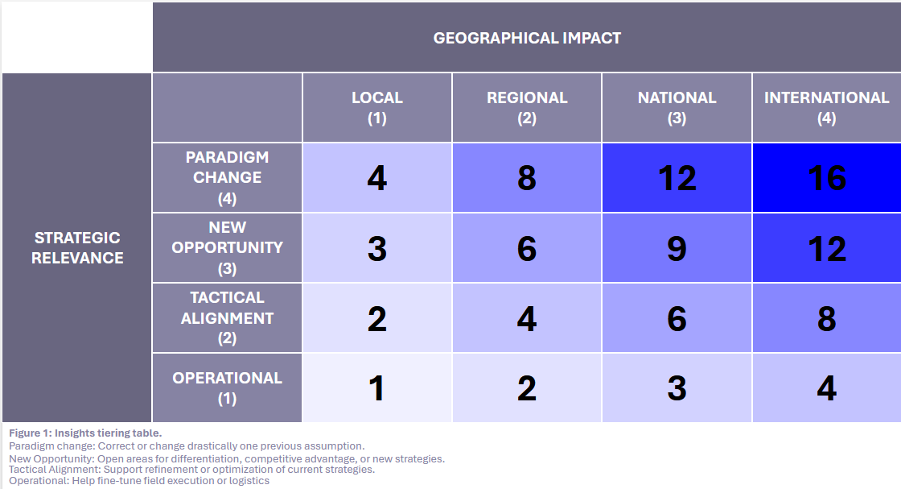
Medical insights are a cornerstone of strategic decision-making, yet their value is often assessed subjectively or inconsistently. This scoring model provides a structured, quantitative way to evaluate insights based on their strategic relevance and geographic or conceptual impact. The goal is to transform insights into measurable KPIs, improving prioritization and demonstrating medical affairs’ contribution to strategy.
Procedure
- Assign a score to each insight depending on how much influences the medical strategy and its geographical impact:
Score = Relevance * Geographical impact
Benefits
- Specific and standardized way to evaluate insights
- Qualitative measure turned into a quantitative one
Potential uses
- Measurable and quantitative KPI of medical insights
Weaknesses and things to improve
- Need for an unbiased classification
- Still not natively quantitative and objective
KOL Tiering with Scoring
Traditional KOL tiering methods often rely on strictly meeting several criteria, limiting their flexibility and long-term tracking value. This model introduces a quantitative, criteria-based approach to KOL classification that reflects both influence level and strategic alignment to each medical department’s needs. It enables more dynamic tracking, tailored weighting by therapeutic area, and clearer support for KOL development planning.
Objective:
Procedure step by step
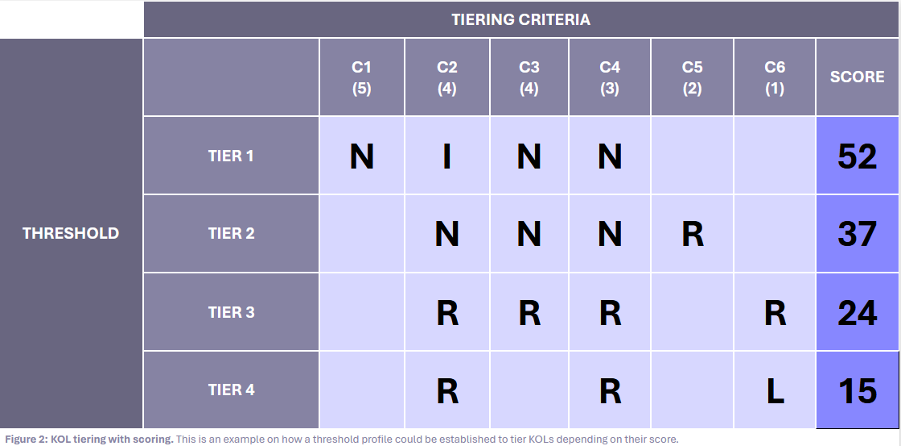
- Decide the relevant criteria to evaluate if the stakeholder is a KOL and how influential (participation in clinical trials, advisory boards, publications…).
- Assign a weight to each of the criteria depending on its relevance for the specific company, therapeutic area and therapy.
- SUM(Criteria met * Geographical impact) is the score for each KOL.
- Establish each Tier threshold creating a profile of the minimum criteria to be considered a KOL of that Tier.
- Fill the table with the criteria met by each KOL to calculate the score and the assigned tier. (This are not strict criteria to be met to be in that tier but the criteria that will get them to the minimum score to be in that tier)
Figure 1: KOL Tiering with Scoring
Strengths and Benefits over traditional KOL tiering
- Allows giving different weights to each criteria depending on its relevance (1-5 to keep it simple)
- More progressive tiering allows seeing which KOLs are closer to a higher or lower tier
- Allows more accurate tracking of KOL progression over time
- Simple to use. Can be prepared as an Excel sheet/CRM to just fill the criteria met with (I/N/R/L) and calculate the score
Potential uses
- More detailed KOL tiering
- Score of individual KOLs could be used as a KPI of their development, especially in the case of rising stars (example: MSL rising stars should have an average increase of 5 points/year)
Weaknesses and things to improve
- The weight of each criteria must be established arbitrarily
- Still not natively quantitative and objective
Conclusion
This approach represents a solid step forward in developing specific and quantitative metrics tailored to medical affairs. It offers a useful, standardized, and easy-to-implement procedure that builds on traditional methods with minimal additional effort. At the same time, it remains flexible enough to adapt to different organizations and therapeutic areas. By transforming qualitative inputs into measurable outputs, it adds structure to data, making it easier to interpret and apply. While medical metrics will always retain some degree of subjectivity, there is still room to improve towards greater objectivity, and we should try to actively pursue it.
About the author:

Marc Piniés Prat, PharmD
I’m Marc Piniés Prat, a pharmacist with a multidisciplinary background in drug discovery research, bioinformatics, and artificial intelligence. I hold a master’s degree in Medical Affairs and currently work in the Medical Affairs department, focusing on Medical Excellence and Operations. My role involves improving internal processes and promoting the integration of technology to enhance the efficiency and impact of medical teams. I’m passionate about bridging science, data, and strategy to drive innovation in the pharmaceutical industry.
Have an opinion on this article? Send a message to the editor.