Medical Affairs is often described as a function in transformation. Yet, for many of us working in this space, that description is already outdated. In practice, the transformation has largely happened. What we are seeing now is not an early signal of change, but the operational reality of the role.
One of the clearest places where this reality becomes visible is in MSL recruitment processes.
Through my work as a mentor in MSL Expert & Mentoring, I have supported many professionals preparing for Medical Affairs interviews. Over time, I have seen how the assessment itself often reveals what a company truly expects from an MSL. More than a hiring exercise, it becomes a reflection of how that organization understands the role in real life.
For that reason, MSL selection assessments are worth examining. They show, with increasing clarity, that the role of the Medical Science Liaison (MSL) is no longer defined only by scientific communication. It is increasingly defined by the ability to connect science, insights, stakeholders, and strategy.
From scientific expertise to strategic contribution
Traditionally, MSL assessments were based on a scientific paper presentation. Candidates were asked to review a publication, usually linked to a pivotal clinical trial, and present their interpretation. This format evaluated core foundations of the role: literature appraisal, scientific rigor, communication skills, and clinical understanding.
Those foundations still matter. Scientific excellence remains central to the MSL role. Without scientific depth, there is no real credibility in peer-to-peer engagement with healthcare professionals.
What has changed is that scientific expertise on its own is no longer enough to reflect the full reality of the role.
Today, MSLs operate in a much more complex environment where clinical evidence interacts with access, institutional priorities, patient needs, healthcare system constraints, and broader organizational strategy. This is consistent with how Medical Affairs has evolved from a support function into a strategic connector between R&D, Commercial, and the healthcare ecosystem [1,2].
That is why the traditional scientific-paper exercise has increasingly evolved into something broader.
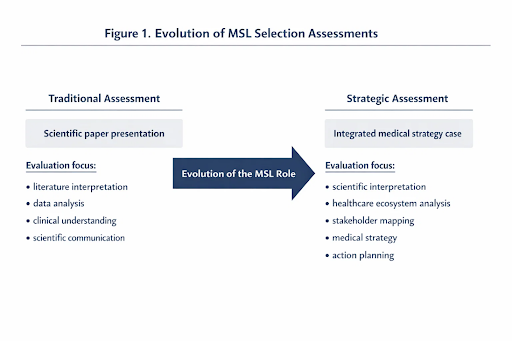
Instead of asking only whether a candidate can explain the science, many organizations now ask whether the candidate can understand what that science means in context. The assessment is shifting from scientific presentation toward strategic interpretation.
What companies are really assessing now
In many current MSL selection processes, candidates are no longer asked simply to explain a study. They are asked to think more broadly. They may be asked to analyze the medical landscape of a therapy area, identify unmet needs, map relevant stakeholders, anticipate barriers to implementation or access, and propose scientific engagement priorities.
This means that the assessment is no longer asking only: Can this person explain the evidence? It is also asking: Can this person understand what the evidence means in the real world? Can this person connect science with the healthcare ecosystem? Can this person think like a Medical Affairs professional, not only like a scientist?
From a mentoring perspective, this is where many candidates struggle. Not because they lack knowledge, but because they often prepare for interviews as if the role were still narrower than it really is.
In practice, many companies are already looking for professionals who can operate with a broader strategic mindset. This aligns with the growing role of Medical Affairs in evidence generation, stakeholder engagement, lifecycle planning, and healthcare transformation [2-4].
The MSL as an insight generator
One of the clearest signs of this evolution is the increasing importance of insights.
The Strategic Scientific Partner is not only expected to communicate data. The MSL is expected to recognize patterns, identify unmet needs, interpret what stakeholders are saying, and translate those observations into something useful for the organization.
That is very different from simply collecting feedback.
It requires listening, contextual understanding, scientific judgment, and strategic interpretation. A useful definition from the literature describes an insight as a deeper understanding of the “why” behind trends in information that helps determine whether action is warranted [5].
MSLs sit in a unique position within the healthcare ecosystem. Through conversations with clinicians, investigators, institutions, and other stakeholders, they often detect the tension points of the system before they are visible elsewhere. They hear where the data resonates, where it creates uncertainty, and where practice still does not reflect the evidence.
That is why the MSL role has become increasingly important not only for scientific exchange but also for organizational learning.
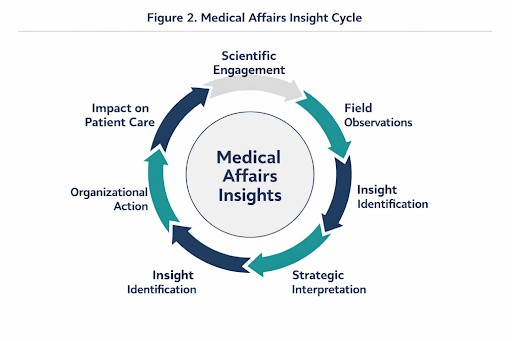
Scientific engagement leads to field observations; observations become insights; insights inform strategic interpretation; and that interpretation can support organizational action and, ultimately, patient care.
Beyond the product: understanding the ecosystem
Another major difference in current assessments is the emphasis on the broader healthcare ecosystem.
Candidates are increasingly expected to think beyond the product and beyond the publication. They need to understand that the value of Medical Affairs does not live only in data dissemination. It also lives in how science interacts with clinical pathways, institutional priorities, access dynamics, payer expectations, patient realities, and cross-functional decisions.
This is one of the reasons why many assessments now include stakeholder mapping, action planning, or strategic case resolution.
The MSL is increasingly being evaluated as someone who can operate in two complementary directions: inside-out, translating scientific evidence into valuable external engagement; and outside-in, bringing stakeholder needs and ecosystem realities back into Medical Affairs strategy [1,6].
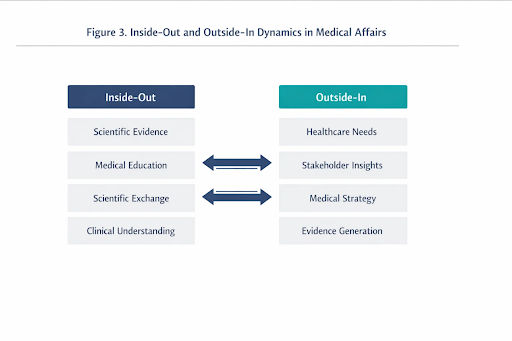
This is not a theoretical model. It reflects how many Medical Affairs teams already work.
Medical Affairs across the lifecycle
Another reason why the paper-only assessment has become insufficient is that Medical Affairs contributes across the full lifecycle of a medicine. This includes identifying evidence gaps before launch, engaging experts early, supporting data generation, informing scientific positioning, generating post-launch insights, and contributing to real-world evidence and lifecycle optimization [2-4,7].
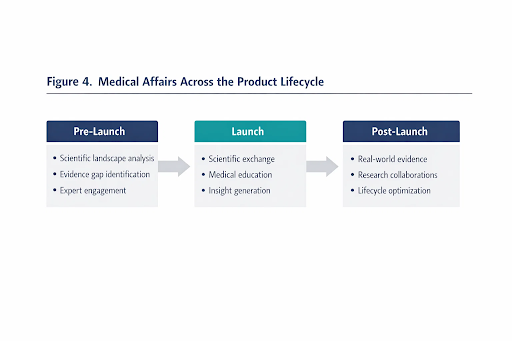 This lifecycle contribution reinforces the idea that the MSL role must increasingly be understood within a strategic continuum rather than as a narrow, tactical field function.
What does this mean for the future MSL
If we are honest about the day-to-day work of many MSLs, then we also need to be honest about the profile the role now requires.
Scientific expertise remains essential. But in addition, the role increasingly requires insight generation, ecosystem intelligence, evidence literacy, strategic thinking, communication adaptability, and understanding of healthcare value. These expectations are consistent with competency frameworks now emerging in Medical Affairs [8,9].
From my perspective as a mentor, one of the most important mindset shifts for candidates is this: they need to stop seeing the MSL role only as a scientific communication role and start seeing it as a strategic Medical Affairs role that happens to be field-facing.
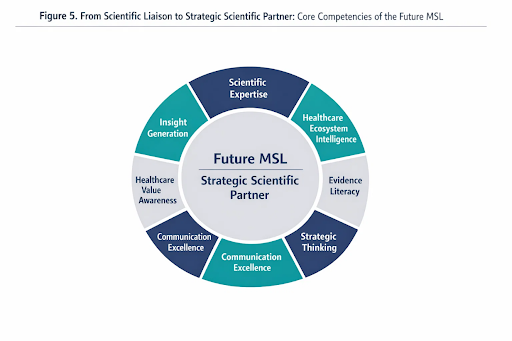
That evolution does not make the role less scientific. It makes it more complete.
Final reflection
MSL selection assessments are becoming more strategic because the role itself is already more strategic.
That is the real message.
We are not looking at a hypothetical future model. We are looking at a profession that has already expanded in scope, complexity, and value.
Many candidates still prepare for interviews as if they only need to prove scientific knowledge. But what companies increasingly want to see is whether the candidate can think, interpret, connect, and contribute like a true Medical Affairs professional.
The Strategic Scientific Partner is still a scientific expert. But not only that.
The Strategic Scientific Partner is also an insight generator, a scientific connector, and a strategic partner within the healthcare ecosystem.
And in many teams today, that is no longer the future of the role. It is simply the reality of the work.
References
- Dhanda A, Frøstrup AG, Dahl P. The value and deliverables of Medical Affairs: affiliate perspectives and future expectations. Pharm Med. 2023;37(6):417-24.
- Leal Beckouche M, Resler Plat G, Marinich JA, Moreno C, Moreno M, Gostkorzewicz J, et al. The evolution of Medical Affairs central teams: shaping strategic action and driving healthcare transformation through scientific interaction. Pharm Med. 2026;40(1):9-18.
- Regadera L, Pérez Domínguez A, et al. The evolution of in-field Medical Affairs: introducing the Strategic Scientific Advisor. Pharm Med. 2025.
- Medina J, Sánchez-Covisa J, Nuevo J, Galvez-Fernandez M, García A, Pimentel B, et al. Shaping the future of evidence generation: real-world data to drive healthcare transformation and patient-centered decisions. Pharm Med. 2026.
- Cadogan AA, Lau J, Wnorowski S, Kelsch GR, Oreper J, Chavez L, et al. Defining insights. Ther Innov Regul Sci. 2023;57(6):1229-37.
- Farrington AD, Frøstrup AG, Dahl P. The value and deliverables of Medical Affairs: affiliate perspectives and future expectations. Pharm Med. 2023;37(6):417-24.
- Jandhyala R. Guest editor foreword: real-world evidence and Medical Affairs. Curr Med Res Opin. 2023;39(12):1537-9.
- Weekes A, Britland M, Saha C, McErlane S, Ansari N, Thurley D, et al. Development of a competency framework for Medical Affairs professionals in Australasia. Pharm Med. 2025;40:61-8.
- Gupta SK, Nayak RP. An insight into the emerging role of regional medical advisor in the pharmaceutical industry. Perspect Clin Res. 2013;4(3):186-9.
Alternative Author’s Note
This article was conceptualized and authored by Martina Riosalido, MSc, PhD candidate, with the support of artificial intelligence tools, including ChatGPT for language support and manuscript structuring, and Sora for the conceptual design and generation of accompanying visual figures. All written and visual content was critically reviewed, validated, and finalized by the author to ensure accuracy, relevance, and alignment with her professional expertise and independent scientific judgment.
About the author:
Martina Riosalido, MSc, PhD candidate
Martina is the founder of MSL Expert & Mentoring, a strategic mentoring and training initiative created to support the development of Medical Science Liaisons and Medical Affairs professionals across the pharmaceutical and biotechnology industries. With more than 20 years of experience in scientific engagement, medical strategy, and international leadership, she is the creator of the proprietary MARIPOSA Method®, a framework designed to transform individual potential into strategic, purpose-driven talent. Her work sits at the intersection of science, communication, and ethical leadership, with a strong focus on empowering the next generation of MSLs. More information is available at www.mslmentoring.com.
Have an opinion on this article? Send a message to the editor.