Abstract
Patient engagement is widely recognized as a priority across the life sciences industry. Yet many organizations still struggle to translate patient insights into meaningful operational decisions. Medical Affairs professionals sit at a unique intersection of science, clinical practice, and patient experience. This article explores how Medical Affairs/MSLs can move patient advocacy from conversation to execution by integrating patient insights into development strategy, clinical trial design, and cross-functional decision-making.
Introduction
This article examines how Medical Affairs/MSLs can operationalize patient advocacy by translating patient insight into real-world decisions that improve clinical development and patient outcomes.
In one real-world scenario, a routine outpatient surgical plan revealed a critical gap. A patient with multiple comorbidities and limited mobility was scheduled for same-day discharge. As more procedures shift to outpatient settings to improve efficiency and reduce cost, the margin for misalignment between protocol and patient reality becomes smaller. What appears appropriate on paper can quickly become unsafe without consideration of the patient’s full context. While the plan met clinical criteria, it did not reflect the patient’s ability to safely recover outside a monitored setting. Only after additional questioning and advocacy was the plan adjusted.
This situation is not unique. It reflects a broader challenge seen across healthcare and drug development. This same disconnect between clinical intent and patient reality is amplified in clinical development, where protocol decisions directly impact feasibility and outcomes.
Most organizations value patient insight and engage with patient advocacy groups. However, those insights often remain disconnected from the systems that drive decisions. Closing this gap requires more than intention. It requires structure. Empathy without structure creates noise. Structure without empathy creates harm. Impact requires both.
The Growing Importance of the Patient Voice
Patient engagement has evolved from an aspirational concept to a strategic expectation across the development lifecycle. Regulatory and industry frameworks increasingly emphasize the importance of incorporating patient perspectives into drug development. The U.S. Food and Drug Administration has formalized this through its Patient-Focused Drug Development initiative, reinforcing the need to systematically capture and apply patient experience data in decision-making [1].
Despite this progress, many Medical Affairs teams still struggle to demonstrate how patient input changes decisions in practice.
Patient advocacy organizations bring forward perspectives that extend beyond traditional clinical endpoints. They illuminate the lived experience of disease, the daily tradeoffs patients make, and the practical barriers that influence access to care and trial participation. When these insights are integrated effectively, they can improve trial feasibility and support recruitment and retention when applied to protocol design and patient experience. However, the presence of insight alone does not guarantee impact.
Why Medical Affairs Is Uniquely Positioned
Medical Affairs occupies a critical position at the intersection of science, clinical practice, and patient experience. Through ongoing engagement with clinicians, investigators, and patient communities, Medical Affairs professionals are often the first to identify disconnects between clinical intent and real-world feasibility.
These gaps are not always obvious during protocol design. They may emerge as visit schedules that do not align with standard care, logistical burdens that limit participation, or recruitment strategies that fail to reach the appropriate patient populations. In other cases, communication is scientifically accurate but not actionable for patients or caregivers.
Because Medical Affairs operates across functions and maintains external credibility, it is uniquely positioned to translate these insights into actionable recommendations. The role is not limited to communicating science. It includes ensuring that scientific strategy can be implemented effectively in real-world settings.
Moving from Listening to Implementation
Listening to patients and advocacy groups is necessary, but it is not sufficient. The value of patient engagement emerges only when insights influence decisions.
Structured engagement approaches such as advisory boards, patient interviews, and partnerships with advocacy organizations have been associated with measurable improvements in clinical trial design and execution [2]. These insights can lead to meaningful operational changes, including reducing protocol burden, improving access through logistical support, refining recruitment strategies, and enhancing patient-facing materials.
In one neuro-oncology program experience, the absence of patient advocacy input during Phase 2 protocol design led to an MRI schedule that was nearly double the standard of care. From a clinical perspective, the design was defensible. From a patient perspective, it was not feasible. Patient advocacy groups later made clear that many patients would not be able to comply with multiple MRI visits per month due to travel, cost, and functional limitations. The protocol required revision before effective enrollment could occur, delaying study progress and highlighting the operational risk of excluding patient voice early.
Integrated input from Medical Affairs and MSLs alongside patient advocacy groups would have surfaced this feasibility gap earlier by aligning scientific intent with real-world patient burden before protocol finalization.
In practice, even small adjustments informed by patient and caregiver input can significantly improve trial performance and patient experience. This often includes translating patient feedback into protocol amendments, site-level adjustments, or changes in patient-facing materials. Insights alone do not change outcomes. Decisions and follow-through do.
Building Effective Advocacy Partnerships
Sustained impact requires more than engagement. It requires structured, trust-based partnerships with patient advocacy organizations. Organizations that are effective in this space define the purpose of engagement clearly, establish expectations upfront, and maintain transparency in how insights will be used.
Transparency, in this context, is not simply communication. It is a repeatable workflow. It begins with a clear ask, followed by timely synthesis of insights, explicit explanation of what changed and what did not, and a visible effort to close the loop with stakeholders.
The Clinical Trials Transformation Initiative highlights the importance of early and ongoing engagement with patient groups, supported by defined processes and consistent communication [3]. When these elements are in place, trust strengthens and engagement becomes more efficient and impactful.
A Practical Framework for Medical Affairs Teams
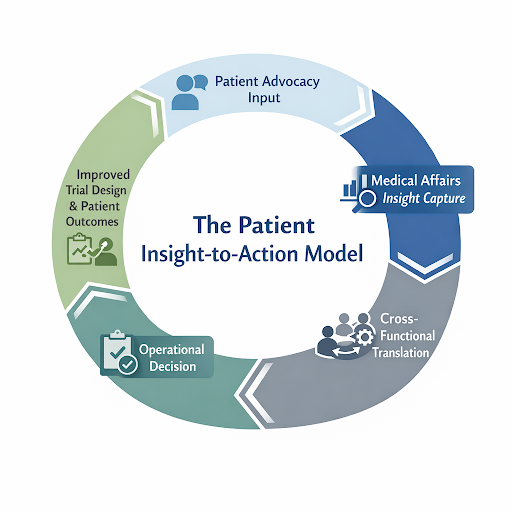
Operationalizing patient advocacy requires a structured and repeatable approach. Medical Affairs teams can begin by identifying relevant patient communities early in development and engaging them through structured interactions. Insights must then be translated into formats that support cross-functional decision-making, ensuring that clinical, regulatory, and access teams can act on them.
Implementation requires translating insights into concrete changes in protocol design, recruitment strategy, and patient support. Finally, measurement and feedback are essential to sustain credibility. Tracking the impact of engagement and communicating outcomes back to patient partners reinforces trust and demonstrates value.
When applied consistently, this approach transforms patient engagement from an isolated activity into an operational capability.
Conclusion
Patient advocacy is not simply an external engagement function. It is a strategic input that can improve the quality, relevance, and execution of drug development.
Medical Affairs professionals are uniquely positioned to translate patient insight into action. By combining empathy with structure, they ensure that patient perspectives inform not only communication, but decision-making.
The future of Medical Affairs will extend beyond scientific exchange. It will be defined by the ability to ensure that science is shaped and delivered in ways that reflect how patients actually live.
| Action Area | What to Do |
|---|---|
| Treat patient insight as input | Use patient feedback to inform decisions, not just context |
| Identify real-world gaps | Look for disconnects between protocol and clinical reality |
| Engage early | Involve patient groups before key decisions are made |
| Translate insights | Convert feedback into clear, actionable recommendations |
| Close the loop | Show how input influenced outcomes |
| Measure impact | Track changes in trial feasibility, access, and engagement |
References
- U.S. Food and Drug Administration. Patient-Focused Drug Development: Collecting Comprehensive and Representative Input. 2020.
- Levitan B, Getz K, Eisenstein EL, et al. Assessing the financial value of patient engagement. Therapeutic Innovation & Regulatory Science. 2018.
- Clinical Trials Transformation Initiative (CTTI). Effective Engagement with Patient Groups Around Clinical Trials.
AI Acknowledgment
Generative AI tools were used to support structuring, editing, and language refinement. All content, interpretations, and conclusions are the author’s own.
About the author:

Gregory Grevera, DNP, FNP-BC, BCPA
Have an opinion on this article? Send a message to the editor.