Introduction:
Artificial intelligence (AI) has revolutionized various industries, including healthcare and pharmaceutical and has proven to be a powerful tool to improve processes and achieve efficiencies. This article discusses a case study of Generative AI (Gen AI) tools applied to insights writing within MSD’s Field Medical affairs team. This approach not only encouraged the creation of insightful content but also implemented a scoring mechanism to evaluate the quality and effectiveness of the prompts provided to the tool, as well as the final output. This combination will result in improvements in the efficiency and productivity of the Field Medical team, enhancing their ability to generate meaningful insights.
Context:
Field Medical (FM) affairs departments in the pharmaceutical industry face multiple challenges related to the large number of resources they need to process and prioritize, which might impact the most valuable data for personnel interacting with external stakeholders: the insights.
Insights are key drivers of strategy and tactics, essential to understand, guide, and tailor the real needs, concerns, expectations, and behaviors of multiple stakeholders (including the company, patients, and the medical and scientific community), ultimately resulting in concrete actions that create enormous value for this ecosystem. Understanding the impact of insights, allows FM affairs teams to establish stronger relationships with the external stakeholders, ensuring that their voices are being heard. Therefore, the impact of insights must be evaluated in terms of quality and effectiveness, rather than the number of insights generated.
In regions such as Latin America (LATAM), where FM affairs teams are usually small and must manage multiple responsibilities, capturing these interactions in a systematic, easy, yet high-quality way is a real dare. Alignment on the definitions and interpretation of insights is also crucial in FM affairs teams to ensure clarity and efficient communication. Lack of alignment compromises the team’s ability to generate and apply FM tasks effectively, ultimately impacting strategic outcomes.
Gen AI, a subset of AI that employs machine learning algorithms to create new and original content based on provided data (see references) presents as an opportunity to optimize the insights development process and free up time for medical affairs professionals to focus on other critical tasks. The Medical Affairs Professional Society (MAPS) suggested framework for insights-related activities (see references), recommends the implementation of technology for aggregating, analyzing, and sharing insights across the industry.
Our Program:
As part of MSD’s goal of improving the quality of insights and reducing the time invested in the writing process and following the recommendations of the MAPS, the regional LATAM team used the internal Gen AI tool as a novel approach to insights writing.
We designed a 4-step workshop to get the teams engaged with this pilot (Fig 1). First, we relaunched the internal enhanced training about insights writing, which was then complemented with a hybrid and interactive workshop about insights. Within this workshop, the FM affairs team had the opportunity to raise and solve any insights questions and learn from experts on how traditional and new tools could help them improve their work. Then, we advertised a specific prompt writing training, which was already available in the corporate training platform. Finally, we launched a prompting contest to select and recognize the most creative prompts and accurate outputs.
Fig 1. Model for improving insights writing.
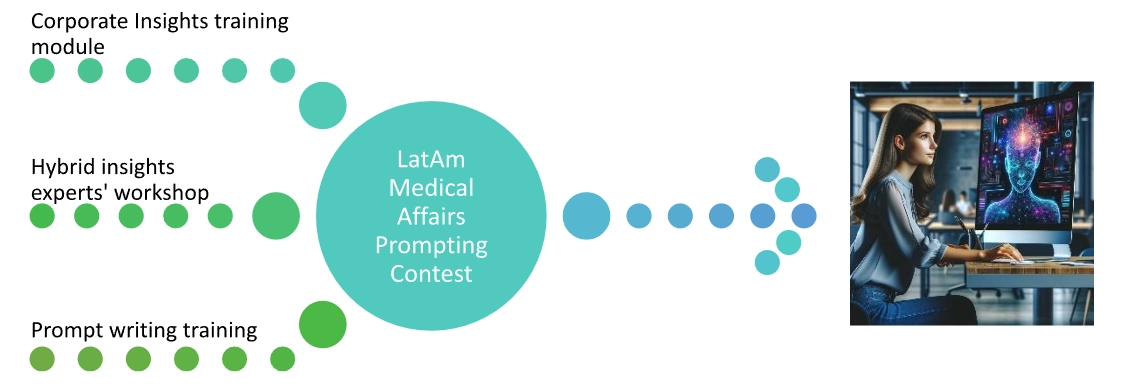
Source: Generated by the authors with support of Gen AI tools.
During this contest, we encouraged the participants to utilize the Gen AI tool to craft prompts for the generation of valuable and accurate insights, using the concepts and training they had received. Once participants had submitted their prompts and insights outcomes, we used our Gen AI tool as an evaluation instrument with a scoring mechanism to assess the effectiveness of the AI-generated prompts and the resulting insights. This assessment was compared with experts’ review of the outcomes to validate the tool’s feedback, help colleagues refine their skills, and allow for iterative improvements in the insights writing process.
This program revealed that Gen AI tools reduce the time required for insights writing and can enhance the quality of the outcomes if the appropriate control metrics are implemented. Based on this experience, we also identified that, in order to effectively use Gen AI in FM affairs teams for insights writing, teams should aim to provide robust training about insights and technology, an opportunity to familiarize with Gen AI, and an evaluation system that verifies the effectiveness of the novel tool.
Once the base knowledge and expertise have been established, the benefits of integrating Gen AI tools in the insights writing process will be reflected in:
- Increased Efficiency: AI-powered tools significantly reduce the time and effort required from FM affairs teams to develop insights. This automation will allow the writer to focus on other critical tasks.
- Enhanced Creativity: Gen AI prompts encourage the writers to explore new perspectives and think outside the box, leading to novel and creative actions based on insights that may have otherwise been overlooked.
- Improved Quality Assurance: The incorporation of a scoring mechanism will provide an objective evaluation of both the prompts and the insights. This will ensure that the AI-generated insights are high quality, accurate, and aligned with the desired objectives.
- Knowledge Augmentation: The AI-generated prompts and insights can contribute to the overall medical knowledge acumen by providing new perspectives, drawing connections between disparate data points, and identifying emerging patterns and trends.
Conclusion:
This experience reflects the potential of Generative AI tools to revolutionize the insights writing process by improving efficiency, enhancing creativity, and augmenting knowledge. The implementation of such tools, along with the appropriate training, will enable insights writers to generate valuable materials that are more streamlined and effective. As AI advances, Field Medical teams must adapt and embrace these tools to meet the growing demands of the healthcare industry.
References:
Arnitage R. Generative AI in medical writing: co-author or tool?. British Journal of General Practice 2024; 74 (740): 126-127. DOI: https://doi.org/10.3399/bjgp24X736605. (https://bjgp.org/content/74/740/126).
CELforPharma. The power of Medical Insights for success in pharma.
Islam N, Van der Schaar M. Use of generative artificial intelligence in medical research | The BMJ] BMJ 2024; 384 doi: https://doi.org/10.1136/bmj.q119 (https://www.bmj.com/content/384/bmj.q119).
Kumar AA. Charting the Future of Medical Writing in the Age of Generative AI – Sciencera. (https://sciencera.org/charting-the-future-of-medical-writing-in-the-age-of-generative-ai/).
McLoughlin M., Jonkman M, and Zivkov M. Holistic Approach to Insights-related Activities Moving to an integrated, in Medical Affairs. MAPS, 2022 (Holistic-Integrated-Insights.pdf (medicalaffairs.org)).
Noble M. Insight to impact: how insights are shaping medical affairs strategies. PMLive, 2023.
Shokrollahi Y, et al. A Comprehensive Review of Generative AI in Healthcare. Arxiv,
arXiv:2310.00795. (https://ar5iv.org/pdf/2310.00795v1.pdf).
Xpertree. The Importance of Medical Insights in Medical Affairs. Linkedin, 2023.
DISCLAIMER: This article was written with the assistance of generative artificial intelligence (Gen AI) tools. While the content has been carefully curated and reviewed, it is important to note that the AI system provided suggestions and prompts that were subsequently refined and crafted by human input. The information presented in this article should be interpreted and evaluated with human oversight and critical analysis. The AI-generated portions were considered as aids to inspire and assist the writing process, and the responsibility for the accuracy and validity of the final content remains with the authors. The images were also generated with Gen AI and MS Power Point.
About the authors:

Catalina Lehmann, MD
Catalina is the General medicine and specialty LATAM Regional Director of Medical Affairs, with more than 12 years of experience in the pharmaceutical industry, mainly in Field-based medical roles as an MSL, Medical advisor, and Health systems manager in different therapeutics areas. Catalina is a physician with a specialization in epidemiology, a master’s in Pharmacoeconomics, and coaching and leadership. Her passions are related to innovating, motivating teams and co-creating strategies that would impact patients’ unmet needs.

Leonardo Capelli, PhD
Leonardo P. Capelli is currently the Field Medical Lead from Value and Implementation Global Medical and Value Capabilities (FM V&I GMVC) at MSD Latin America Hub. In this role, he is responsible for liaising the Global Field Medical organization to the Field Medical members in the LATAM region, providing support and alignments in terms of capabilities and responsibilities to local staff in areas such as Oncology, Infectious Disease, Vaccines, and General Medicine. ‘Leo’ Capelli is a Biologist with a Human Genetics background. Prior to joining Field Medical GMVC LATAM Hub (MSD), Leo was a Case Processor in the Pharmacovigilance team and Oncology MSL at Bayer. After transitioning to MSD, Leo spent five years as Oncology MSL and MSL Excellence for Oncology until being assigned to the GMVC Hub in 2020.

Luis Ricardo Gómez, MD
Luis Ricardo is the innovation & digital transformation regional leader in the Medical & Scientific Affairs organization in MSD LATAM. Is a Physician with over 19 years Development of experience in the Pharmaceutical industry, leading teams in different therapeutic areas in Medical Affairs, Research & Development of experience in the Pharmaceutical industry, leading teams for different therapeutic areas in Medical Affairs, Research & Development or Marketing in Big Pharma Organizations. In the last decade, he has developed the most effective teams and implemented innovative initiatives that increased value for each pharma and biotech company he collaborated with.

Julián Camilo Avendaño Gallo, BS
Julián is a Senior Medical Writer in MSD’s Oncology Results Reporting Team. He has contributed to a variety of documents to support Investigational New Drug Applications (INDs) as well as multiple regulatory submissions in different markets for Oncology and Infectious Diseases therapeutic areas. Julian is a Chemical Engineer with a background in bioinorganic chemistry research and more than 5 years of experience in different Medical Writing roles. He has contributed to several initiatives to implement technology across Medical Writing within MSD.
Have an opinion on this article? Send a message to the editor.