The role of the medical science liaison (MSL) within the medical affairs department is crucial in the pharmaceutical industry, playing an essential role in the exchange of scientific information between the pharmaceutical company and healthcare professionals (HCPs). Defining appropriate metrics and key performance indicators (KPIs) could support the aims described in the medical plan in line with the company’s goals [1].
Establishing suitable KPIs is not only necessary to measure professional performance, but also to observe whether planned strategies are being implemented, detect possible plan updates, and assess the impact the MSL is having in the field [2].
KPIs are divided between qualitative and quantitative metrics, which can offer several ways to evaluate the impact and performance of the professional. To some extent, qualitative variables suggest a broader view of performance, evaluating in a more specific way the quality of the work performed. However, they are more subjective and difficult to measure. Among the qualitative measures are found, for instance, the quality of interactions with the key opinion leaders (KOLs). On the other hand, quantitative metrics offer an objective, quantifiable evaluation of the work carried out by the MSL, such as the number of interactions with KOLs carried out or the number of scientific presentations delivered. These measures can provide performance information in certain aspects; however, the impact of each of them cannot be assessed [2].
Furthermore, within the department itself, there may be differences of opinion stemming from different positions or roles. There may also be differences between countries in how KPIs are evaluated and in the relevance of metrics.
Thus, the primary endpoint of this review is to compare potential differences of opinion regarding the KPIs used to measure MSL performance between the MSL and MSL head positions in the global report, and as a secondary aim, to compare the results provided by the United States of America (USA) with those obtained in Spain based on the global and USA report conducted by the MSL society [3].
MATERIALS AND METHODS
This review analyses the cross-sectional study carried out by the MSL society to evaluate the performance of MSLs. The review evaluated the two documents released in 2024 by the Medical Science Liaison Society regarding the medical affairs field, as well as globally in the USA. These reports represent the second comprehensive assessment conducted by the MSL Society.
Study design
The surveys were previously pretested by a specific group of MSL and MSL head professionals who guaranteed the accuracy of the questions. All participants were part of the medical affairs department. The negative response to belonging to an MSL role or similar was the only exclusion criterion. This questionnaire was distributed via LinkedIn, and only those completed surveys were used for the evaluation conducted for three months (March to May 2024).
In the survey analyzed, a section with responses from all roles in the medical affairs department was found. This makes it easier to see the perspectives as well as the convergences and divergences between positions. The questionnaires consist of multiple-choice questions with five possible answers. For each possible answer, the percentage of respondents is shown. The main topics in the survey include the perception of the importance of qualitative and quantitative metrics used to measure MSL performance; the most used metrics, and whether these metrics properly measure the quality of performance in MSL.
Participants
A total of 1023 professionals from different positions (MSL / Sr. MSL / Medical Advisor (or other equivalent title), Manager / Director of MSLs (or equivalent title), Executive Management/ Vice President of Medical Affairs, MSL Excellence/ Operations, Other) from 63 countries participated in the global report. The report, conducted exclusively in the USA, involved 573 professionals.
RESULTS
MSL vs Managers positions comparison
When comparing the responses between the MSL positions and the managers, there are many points on which MSLs and managers have similar opinions. However, the most remarkable opinion differences found in the surveys are what will be analyzed:
A smaller percentage of managers believe that the most frequently used metric should be qualitative (46%) and the need for a better balance between the two metrics (47%), unlike the MSLs (59% of them think they should be mostly qualitative and 35% should be an equal balance between the two kinds of metrics). (Figure 1). Furthermore, a higher percentage of managers believe that the most used quantitative metric should be the number of KOL engagements (73% of managers vs. 59% of MSLs).
Figure 1. Differences of opinion between MSLs and managers as to which metrics should be used.
Regarding using KOL engagement impact scores, a combined metric that quantitatively assesses the effectiveness and influence of interactions between MSLs and KOLs, in the case of MSLs, 42% think


Regarding using KOL engagement impact scores, a combined metric that quantitatively assesses the effectiveness and influence of interactions between MSLs and KOLs, in the case of MSLs, 42% think it should be used, while 36% do not. Conversely, 61% of managers believe it should be used, while 16% do not, and 23% are unsure. (Figure 2)
Figure 2. Differences in KOL engagement impact score between MSLs and managers.

Regarding the qualitative metrics currently used in companies to measure the performance of MSL, it is noteworthy that 66% of MSLs believe that feedback from the direct manager is currently being used, followed by feedback from the internal stakeholder, with 47%. Among managers, 77% agree with the first point and 59% with the second. As for whether MSL interactions are well-defined, 73% of managers vs. 65% of MSLs think so.
To the question, how do you define the value of an MSL within your organization?” MSL positions showed assigned the highest percentages to “their ability to build and maintain strong relationships with KOLs”(27%), “It’s subjective based on what internal leadership thinks MSLs should be doing to contribute to the company” (29%), and “through the quality and depth of scientific knowledge and expertise they provide” (19%). In the case of managers, they had a similar opinion, however, a lower percentage (17%) believe that “it’s subjective based on to what internal leadership thinks MSLs should be doing to contribute to the company”. (Table 1)
| MSLs | Managers |
| 27% “By their ability to build and maintain strong relationships with Key Opinion Leaders (KOLs)” | 28% “By their ability to build and maintain strong relationships with Key Opinion Leaders (KOLs)” |
| 29% “It’s subjective based on what internal leadership thinks MSLs should be doing to contribute to company” | 17% It’s subjective based on what internal leadership thinks MSLs should be doing to contribute to company |
| 19% “Through the quality and depth of scientific knowledge and expertise” | 20% “Through the quality and depth of scientific knowledge and expertise they provide” |
Table 1. Differences between MSL and manager positions in terms of defining de value of MSL’s role in the organization (majority response percentages).
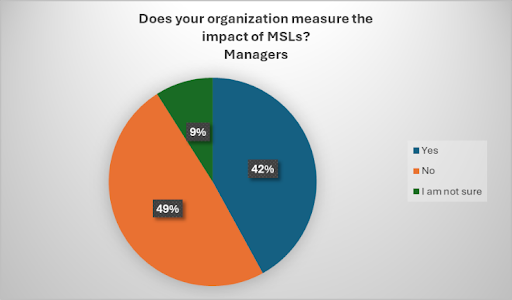
Furthermore, depending on the company, 42% of managers believe that their company does measure the quality of MSL performance, while the remaining 49% of respondents believe it is not clear enough. In the case of MSL positions, a higher percentage (39%) think the impact of MSL is being measured, compared to 33% who think it is not. Twenty-eight percent of respondents claimed not to be sure. (Figure 3)
Figure 3. Differences of opinion between MSLs and managers as to whether the company measures the impact of the MSL.

Both positions found difficulty in measuring MSL performance and both proposed similar ideas such as a “higher development opportunity and enhanced communication and feedback loops” could be a way as indicators of the achievement of MSL aims in line with company goals, although in the case of managers, the “implementation of technology to improve performance” obtained a higher percentage.
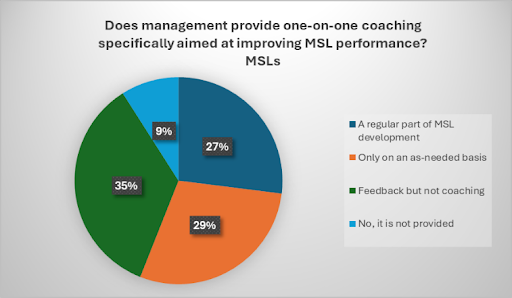
Finally, there were mixed responses regarding whether the manager offers one-on-one coaching to improve MSL performance. A total of 35% of MSLs believed they did receive feedback but not coaching, while 58% of managers believed coaching was a regular part of MSL development. (Figure 4)

Spain vs USA comparison
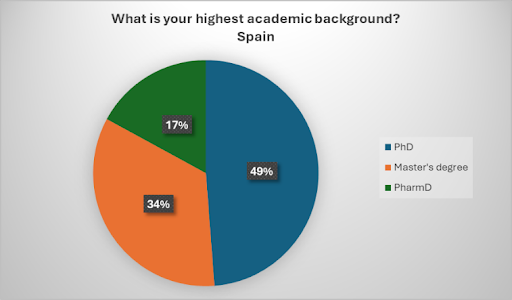
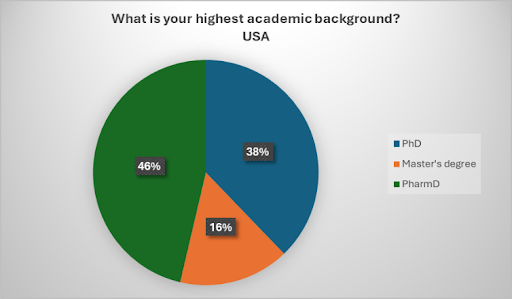
When USA and Spain reports were compared, certain differences were also found. While in Spain, the majority (42%) work for a large pharmaceutical company, in the USA, there is more balance between working for large, medium-sized, and small pharmaceutical companies. Furthermore, when we compared both countries, in Spain, a higher percentage (40%) hold a PhD, and 28% hold a master’s degree, while in the USA, 38% hold a PharmD, 31% hold a PhD, and only 13% hold a master’s degree.
Figure 5. Differences between Spain and the USA according to the highest academic background achieved.
Regarding the weight given to different metrics, 70% of MSLs in Spain believe the qualitative metrics should be used. However, in the US, 55% believe qualitative metrics should be used, but 39% believe there should be an equal balance between the two.
There were also differences in the quantitative measures currently used. Both countries agree, with a majority percentage, that the most commonly used measure is the number of KOL engagements. However, in Spain, 60% believe that the number of scientific presentations delivered is a common measure. In contrast, in the USA, 52% believe it is the number of actionable insights submitted, and the same percentage believes it is the number of KOL relationships maintained.
Regarding the quantitative measures that should be used in the USA, they coincide with those used, while in Spain, 72% believe that the number of KOL engagements is followed by 60% the number of scientific presentations delivered, and 60% the number of internal projects.
Regarding qualitative measures, both countries agree on the ones currently used. However, regarding those metrics that should be analyzed, in Spain, 70% believe in involvement in strategic planning, and 68% believe in actionable insights, involvement in medical strategy, and expanding KOL/HCP scientific knowledge. In the USA, 72% believe that “Quality of KOL/HCP relationships and/or engagements” should be used, followed by “Quality of Actionable Insights gathered” and “Feedback/observation from direct manager”.
Spain vs global comparison
When comparing Spain vs global data, we observed no significant differences in the therapeutic area in which they work. In terms of positions, there is a slightly higher percentage of MSLs in Spain compared to the global data.
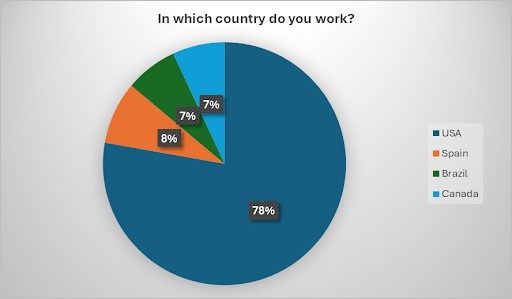
Spain appears to be the second most responsive country (6%) after the USA (56%), followed by Brazil and Canada with 5% each. It is observed that globally, only 18% carry 3 products, while in Spain, 23% would reach this number.
Figure 6. Countries with the highest percentage of answers.
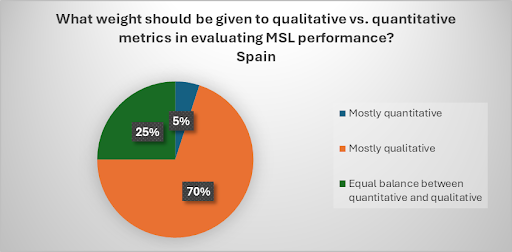
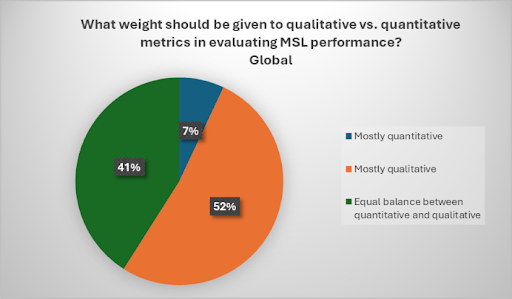
When evaluating which metrics to use, 70% of respondents in Spain believe that qualitative metrics are the most suitable, while 25% believe there should be an equal balance between the two. However, at a global level, 52% believe that qualitative metrics are the most suitable, while 41% believe that a balance between qualitative and quantitative metrics should be used.
Figure 7. Differences of opinion regarding the metrics that should be used in Spain vs. the Global
Regarding the quantitative metrics currently used, both countries, with more than 90% of respondents, believe that it is the number of KOL engagement, however, in Spain, it is followed with 60% of scientific presentations delivered and with 44% respectively, the number of KOL relationship maintained and number of actionable insights. However, in the global case, the second most used quantitative metric would be the number of actionable insights (53%), followed by 51% of KOL relationships maintained and 49% of scientific presentations delivered.
When analyzing the quantitative metrics that should be used, among the highest percentages were: 64% the “number of KOL participation”, 63% the “number of actionable knowledge”, and 58% the “number of KOL relationships maintained”. On the contrary, in Spain, the highest percentage (72%), as in the global report, is the number of KOL engagements, but in contrast, 68% believe it should be the “number of scientific presentations made” and 60% the “number of internal stakeholder projects”.
Differences were also found in terms of the qualitative metrics most suitable to use. In the global report, 70% should be “Quality of KOL/HCP relationships and/or engagements,” 67% the quality of actionable insights, and 63% “Expanding KOL/HCP scientific knowledge of disease.” While for Spain, 70% should be “involvement in strategic planning” and 68% “involvement/contribution to medical strategy” and “quality of Actionable Insights gathered”.
Table 2. Differences between Spain and globally, according to the qualitative metrics that should be used (the highest percentage of responses).
| Global | Spain |
| 70% “Quality of KOL/HCP relationships and/or engagements” | 70% “Involvement in strategic planning” |
| 67% “Quality of Actionable Insights gathered” | 68% “Quality of Actionable Insights gathered” |
| 63% “Expanding KOL/HCP scientific knowledge of disease state, product, TA, etc.” | 68% “Involvement/contribution to medical strategy” and “Expanding KOL/HCP scientific knowledge of disease state, product, TA, etc.” |
DISCUSSION
The results showed similar answers across many parameters and certain differences as well. When comparing MSL positions and managers, the most significant differences lie in using quantitative or qualitative metrics, using the KOL Engagement Score, whether and how the value of MSL is defined, and the manager’s use of coaching. Regarding global and USA comparisons, the most notable differences are the academic level of the professionals, whether the organization accurately measures the impact of MSL, or whether KOL feedback is used as a metric.
This demonstrates that, for MSL positions, qualitative metrics are the predominant approach, despite being more subjective and non-quantifiable. However, in management positions, a balance between the two would be the chosen option. This may also explain the higher percentage of managers using the KOL Engagement Impact Score. Regarding other aspects, such as coaching, improvements in strategies that adequately assess MSL performance differ between the two positions. While individual coaching is a good strategy to improve MSL development, according to MSLs, managers’ feedback is the only approach carried out in most cases, contrary to the opinions of managers. This may vary depending on the way each company operates, and implementing it may not always be feasible. Thus, feedback is what is prioritized.
Comparing global and USA reports, the academic degree could show the differences in academic requirements established in each country. It is especially noteworthy that in the USA, there is a higher percentage of PharmD and a lower percentage of master’s degrees compared to the USA.
The recently published article by Dyer et al. [4] was one of the first indexed articles and the first major global survey conducted to assess these aspects. Its objective was to evaluate the current and perceived use of quantitative and qualitative metrics in MSL performance, which generated the need for an evaluation system that includes both metrics that adequately measure MSL performance.
The global report on which this study is based reiterates the need for a re-evaluation of the methods used to measure MSL performance. Despite the differences of opinion among positions, one thing is clear: the need to establish qualitative metrics alongside quantitative ones and achieve a balance between them without losing the reliability of the evaluation methods. The objective is none other than to limit performance evaluation to a quantifiable measure, but also to combine the impact of the MSL activities in achieving the company’s overall objective. A more strategic view of the impact of MSL could be provided using goal-oriented metrics, as Dyer described [5].
Currently, field medical teams are already adopting new strategies for qualitative KPIs [2]. Furthermore, the rise of new technologies and the emergence of artificial intelligence (AI), which has also brought about a change in the sector, with several applications in both resource optimization and innovation, could also be an effective tool to help in the performance of the MSL and maybe in the metrics used for its evaluation. In addition to these advances, other examples of emerging qualitative KPIs are medical insights, KOL sources, or surveying [2], as the two reports we have evaluated in this study have also been analyzed.
As a limitation, given the fact that the USA is the country with the highest number of answers, this could bias the results.
CONCLUSION
Despite the actual differences between positions within the Department of Medical Affairs and between global and USA that must be considered, there are also many similarities between them. This study also reiterates the need to re-evaluate the metrics used by prioritizing the use of qualitative metrics in combination with quantitative ones with the aim of having an overall view of the MSL impact.
REFERENCES
- How to Approach Medical Science Liaison (MSL) Key Performance Indicators Available online: https://www.pharmaccelerator.com/blogs/how-to-approach-medical-science-liaison-key-performance-indicators (accessed on 20 April 2025).
- Field Medical Metrics/KPIs Guidance Document – Medical Affairs Professional Society Available online: https://medicalaffairs.org/field-medical-metrics-kpis/ (accessed on 20 April 2025).
- KPI Survery – MSL Society Available online: https://themsls.org/field-medical-affairs-kpi-metrics-report/ (accessed on 2 June 2025).
- Dyer, S.; Hyder, C.; Kraemer, J. Challenges of Key Performance Indicators and Metrics for Measuring Medical Science Liaison Performance: Insights from a Global Survey. Pharmacy 2025, Vol. 13, Page 51 2025, 13, 51, doi:10.3390/PHARMACY13020051.
- Dyer, S.Jacob. The Medical Science Liaison Career Guide : How to Break into Your First Role : A Hiring Manager Reveals the Secrets for Success! 2014, 183.
About the authors:

Verónica Melero, PhD
Verónica Melero holds a PhD in Endocrinology and Nutrition and a master’s degree in Personalized Nutrition Science. Her areas of expertise include metabolic disorders (diabetes, obesity, metabolic syndrome), as well as women’s and children’s health. Her professional background includes prior clinical and basic research experience in several Spanish hospitals. She is the author and co-author of over 10 scientific articles published in high-impact journals and has attended several scientific conferences in this field as a speaker. Her keenness on health innovation and passion for learning have led her to continue studying, and she is currently pursuing the Senior MBA in Pharma and Biotech at ESAME to head her professional career toward the Pharmaceutical Industry. As highlighted in the article, her interest in the scientific profile, as well as all the activities encompassed by the Medical Affairs Department, makes it the field she would like to be part of.

Claudia Conesa, MBA
Claudia Conesa holds a degree in Pharmacy and a Pharma MBA. She is currently an MSL in Amgen, with responsibility in Bone Metabolism, Neuroscience, Inflammation, and Rare Diseases. She has more than 5 years of experience in the Pharmaceutical Biotech industry in the Medical Affairs and R&D department, and has participated as a co-author on several MSLS Journal Articles since 2019.
Have an opinion on this article? Send a message to the editor.