In a survey of key opinion leaders (KOLs), 94% agreed that scientific exchange between clinical experts and biopharmaceutical companies is becoming more important. While this is positive for medical affairs, resources don’t always go hand in hand with demand. As the global head of medical affairs excellence at a top 20 biopharma acknowledged at the Veeva Commercial Summit, “Deploying the same strategies and people across different assets and products is not sustainable, nor strategic. We have to be a nimble organization when it comes to engaging with our customers, we need to learn how to grow and evolve.”
Medical teams are looking for ways to maximize their engagements and build on those valuable relationships. Recent Veeva surveys of field medical teams and KOLs indicate two ways to create highly impactful engagements: personalizing interactions and allowing field medical teams to share their scientific opinion for how they interpret the evidence they present and/or what that means for clinical practice. Both can help medical affairs maximize engagement with HCPs and increase efficiency. The report also identified factors that can limit field medical teams from putting these actions into practice, with new data that might be an impetus for some organizations to reconsider current strategies.
KOLs want tailored engagement
Most of us appreciate personalized recommendations and service. It’s not surprising that 81% of KOLs say they want the same when it comes to medical content. A joint survey with the Medical Science Liaison Society (MSLS) and Veeva found that 97% of MSLs and their managers agree it’s important to customize each engagement based on the KOL’s interests, educational needs, and career objectives. Eric Toron, executive director, medical operations lead, global medical and scientific affairs at Merck, underscored, “One of the cornerstones of a great MSL is the ability to customize their engagements based on the totality of evidence coupled with the KOLs’ needs.”
While customized engagement seems to be the clear preference, 66% of KOLs say they experience different levels of customization amongst companies. This could be due to many factors out of the MSL’s control. Some organizations tend to be stricter in limiting content customization to streamline rather than individualize. For example, in a poll during a recent webinar with MSLS and Veeva, only 54% of MSLs indicated that their company allows them to tailor the content they present, 27% stated they cannot tailor content, and 19% are unaware of options for customization.

However, it’s important to recognize that ensuring the right KOL receives the right content at the right time can have a real impact. The majority of KOLs say they take tangible action based on the scientific content presented to them.

This customized engagement is where omnichannel will become critical for medical affairs. The global head of medical affairs excellence at a top 20 biopharma points out, “We have an opportunity to build systems and structures that enable true omnichannel.” Building this foundation starts with segmenting physicians, understanding their needs, developing personalized content for individual personas, and creating tailored journeys. “If we establish the right foundation, then we can scale with our teams and make them more efficient,” he says.
KOLs say it’s acceptable for MSLs to share scientific opinion
According to Veeva data, there’s a split in the industry among MSLs when asked whether it is appropriate for field medical teams to share corporate scientific positions (in a compliant way) with KOLs. Some MSLs say it’s critical in facilitating scientific exchange and partnership. Others view this practice as unacceptable, stating that it might inadvertently introduce bias.
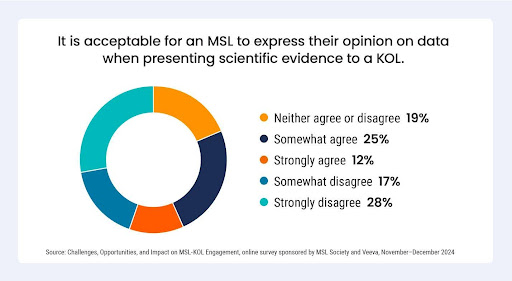
Source: Numbers have been rounded for easy viewing.
KOLs, on the other hand, unanimously agree that biopharma companies — field medical teams specifically — should share their scientific opinion.
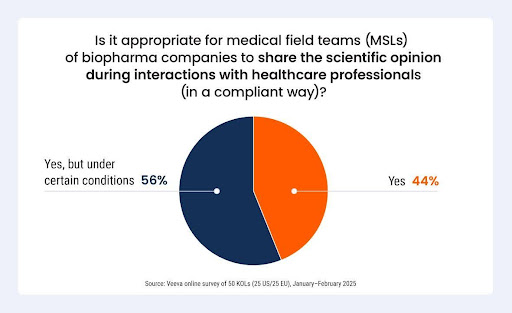
When doing so, over half of the KOLs surveyed believe that MSLs should follow certain conditions — use a fair and balanced view, disclose all underlying evidence, only use scientific augmentation, and avoid marketing language.
Toron weighed in on this matter, “Two important qualities of an effective MSL is that they’re able to genuinely relate to the KOL and establish credibility based on their deep scientific expertise, both of which are difficult to accomplish unless you offer your scientifically-informed perspective on the data and the science.” Toron acknowledges that there needs to be a balance between the company’s perspective and the totality of the data , but says, “If you’re not able to express an appropriate informed and balanced perspective on what it is that you’re discussing, it’s a missed opportunity.”
Overall, KOLs find value in this information and feel it is key for an informed, transparent exchange that helps them form their own position.
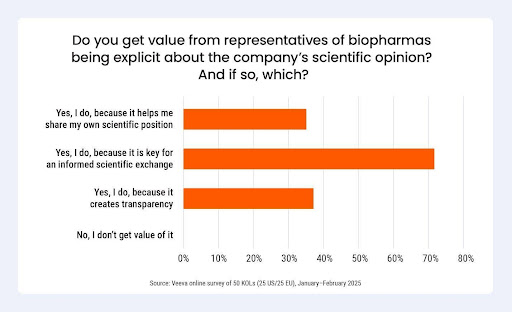
Being a good partner to your KOLs means delivering constant value that translates into a high level of access and good scientific exchange. It also provides the opportunity to gather actionable insights. As Nimisha Rathod Shah, head, global field medical excellence, Johnson & Johnson Innovative Medicine, stated in the webinar with MSLS, “Sharing of scientific opinion allows for open discussion and introduces the right questions. If you don’t have agreement or alignment with your KOLs, understanding why and where they have concerns ultimately enables a more interesting scientific exchange.”
Conclusion
Start maximizing KOL relationships by putting into practice an omnichannel engagement strategy that utilizes personalized interactions and perspectives and opinions based on science and data.
The global head of medical affairs excellence at a top 20 biopharma encourages this approach. “The amount of scientific information that a physician has to digest in order to treat patients the right way increases every day. Medical Affairs, especially our field teams, bring credible, evidence-based information to physicians to help keep them up to date. This is where we become true partners and will continue to shine.”
Sources:
Survey 1: Online survey of 50 KOLs (25 US, 25 EU), March 2025. KOL status qualified by participating in at least three activities: publishing in scientific journals, involvement in clinical trials, speaking at conferences, and contributing to guidelines.
Survey 2: Challenges, Opportunities, and Impact on MSL-KOL Engagement, online survey sponsored by MSL Society and Veeva, Nov-Dec 2024. Total of 317 responses from 39 countries. Responses cited in this report include Executive Management, Vice President of Medical Affairs, Manager/Director of MSLs (or equivalent title), MSL, Senior MSL, Medical Advisor (or equivalent title), and MSL Operations/Excellence/Training, Global Data.
About the author:
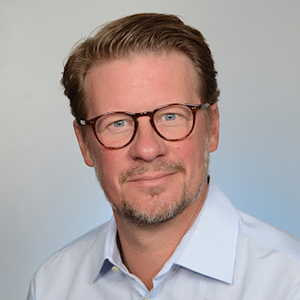
Christoph Bug, MD, PhD, MBA
Have an opinion on this article? Send a message to the editor.