With highly regarded field medical relationships, there is an opportunity for improvement
A recent Veeva industry report shows that 86% of key opinion leaders (KOLs) are satisfied overall (74% satisfied, 12% very satisfied) when engaging with the biopharma industry. They appreciate their interactions with field medical teams and cite alignment and coordination across functions as a key area for improvement.
Optimizing engagement with KOLs, the most important customers, is crucial for the entire organization. But, medical affairs, which is involved earlier and deeper with KOLs have a significant opportunity to take a more strategic role in improving this engagement. They can gain access, engage in scientific dialogue, collect insights, and build trusted relationships for long-term collaboration.
To better engagement and ensure it is mutually beneficial, here are three areas that medical affairs organizations may want to consider as they plan their KOL strategies.
1) Align internal functions
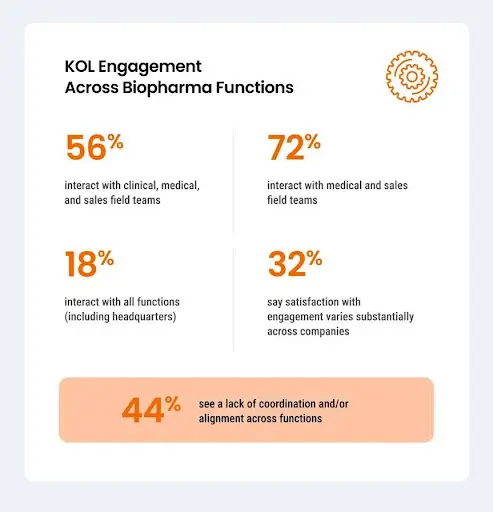
This means in addition to medical affairs, they may also interact with teams across the organization, including clinical, sales, and representatives from headquarters.
While KOLs are satisfied overall with their engagement, 32% say their satisfaction varies substantially across companies. Close to half (44%) say they see a lack of coordination and/or alignment across functions. Examples include receiving conflicting information from different functions and each area having its own focus with no extended vision.
“Some companies give the impression that they work very well together, know each other, and know what they are selling and developing,” says Dr. Vital Hevia, urologist and robotic surgeon at ROC Clinic and HM Hospitals. “At the same time, we see the complete opposite. They don’t know each other — the medical part of the company doesn’t know anything about sales, and vice versa.”
Inconsistent collaboration between different functions can limit company engagement and compromise the overall customer experience. To progress toward the future of more customer-centric engagement, R&D, medical, and commercial can start by setting joint strategies and objectives and gaining buy-in from key stakeholders. By working together in this way, organizations can improve customer experience with less duplication of efforts and more impact, ultimately benefiting patients.
2) Provide value at every interaction
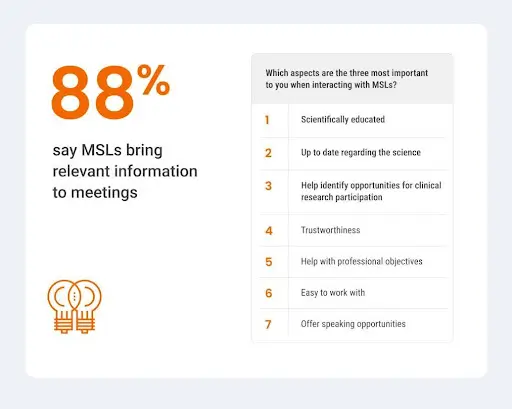
KOLs appreciate their deep scientific exchange with MSLs
Outside of medical education events, participants ranked engagement with MSLs as the second-highest valued information source offered by the biopharma industry. With scientific knowledge and training, MSLs can have more meaningful conversations with KOLs. However, with limited time and access, they need to ensure that every interaction with a KOL is tailored to their specific scientific needs and interests to provide value. “Physicians have limited time and don’t need repetitive information,” says Hevia. “The transfer must be efficient, with scientifically trusted information through the right channel. Every interaction should inform the next communication.”
The good news is that field medical teams deliver on this important factor — 88% of respondents agreed that MSLs bring relevant information to meetings. To further improve engagement and reciprocal exchange, a move from transactional to bidirectional scientific dialogue and collaboration can cultivate trusted relationships that help better leverage these stakeholders’ impact on clinical practice.
3) Streamline assessment of KOL engagement
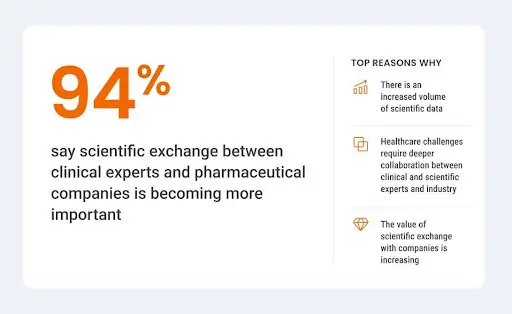
As treatments and therapies become more complex, the need for scientific exchange will only continue to grow, and medical affairs will need to be even more strategic about stakeholder selection and cultivation. A large part of that will be the organization’s ability to assess what is working and where it can improve.
To build better KOL strategies, medical affairs organizations need a way to quantify the “enablers” in this medical impact model. Are they connecting with the right stakeholders, getting them the right information, and bringing key insights back to the organization? Lack of focus, explicit planning, and measurement around these enablers can blind organizations to the cause and effect of their actions. This limits the ability to translate the value of medical affairs across the organization and risks negatively impacting its overall goal of ensuring that science and technologies benefit patients.
Medical teams can have a valuable measured impact
KOLs highly value field medical teams and look to them for relevant material and information that can significantly impact patient outcomes. Providing a unified customer experience, having scientific dialogue rather than a scientific monologue, and delivering tailored, personalized information will lead to more productive interactions. However, without measuring the impact of strategies and tactics, it is impossible to correlate cause and effect and learn to improve. Focusing on these areas can help medical affairs meet its overarching goal of ensuring that science and technology benefit patients.
Read the full report, including the survey methodology, here.
About the author:

Christoph Bug (MD, PhD, MBA), Vice President, Global Medical, Veeva
Christoph is an experienced biopharma executive responsible for Veeva’s global medical strategy. He is a physician by training and has earned a PhD and an MBA. He has held roles in market access, commercial, R&D, and medical affairs on a local, regional, and global levels, most recently as medical lead at Janssen (JnJ) in Germany.
Have an opinion on this article? Send a message to the editor.