I. Overview and Purpose
While the roles, responsibilities, and titles of Field Based Medical (FBM) personnel vary in each organization, they are universally viewed as the scientific experts of the pharmaceutical/biopharmaceutical company and engage in unbiased scientific discussions. Their role encompasses the lifecycle of a product, including pre-approval pipeline assets and marketed products (Figure 1.1). The ability of FBM to work on pipeline assets requires FBM to have an understanding of the drug development process, differentiate itself cross-functionally, and interact with multiple stakeholders. Internally, this may include clinical development teams, and externally, may include clinical research organizations (CROs) and health care providers (HCPs), including physicians, advanced practice providers (APPs), genetic counsellors, nurses, and pharmacists.
While pipeline assets are still in development, FBM personnel operate within a unique position. They regularly interact with HCPs about the disease states of interest and molecules in development. While the Code of Federal Regulations clearly states promotional safety and efficacy claims cannot be made prior to approval, the provision does not restrict the exchange of scientific information (21 CFR 312.7(a)). The relationships developed with HCPs are integral to the provider, patients, and the company. Providers have the greatest understanding of the disease state of interest, how their patients have responded to available treatments, unmet medical needs, what their patients consider advancements in care, and what the care gaps are. A collection of such clinical insights by the FBM team helps guide companies on how to prioritize drug development, how the studies should be designed, how therapies may be perceived, and whether the drug will still be needed and utilized, considering the projected approval timeline.
HCPs get their information from multiple sources – journals, conferences, peers, online learning platforms, blogs, industry representatives, patients, etc. Separating truthful information from misinformation and disinformation can be challenging. FBM personnel can help providers sort through mis- and dis- information by providing the most current literature. The knowledge that FBM brings can assist a provider in making a decision about patient treatment when no approved options are available for the condition, a treatment is not working, or by using unpublished Clinical Study Report (CSR) data on file. The development of strong relationships between FBM personnel and trial site Primary Investigators (PI) and providers in surrounding non-study sites treating the conditions being studied is beneficial in the recruitment of patients to participate in clinical studies.
II. Field Tactics to Support Study Execution and Strategic Insight Generation
From a study execution standpoint, the FBM team provides support in collaboration with the clinical study unit (CSU). Due to their established relationships with HCP networks in different geographies, the field team is able to support site identification and initial site feasibility assessments (patient population, staff bandwidth, investigator expertise). Once a trial is activated, the FBM serves as a direct liaison with the site to identify barriers in recruitment to resolve challenges. For rare disease studies, patient recruitment is often a challenge due to a paucity of patients, protocol complexity, and travel limitations (Figure 1.1). This information can be taken to relevant internal departments (such as clinical development and clinical operations) to determine if solutions can be identified and instituted.
From a strategic standpoint, FBM personnel collect insights that prepare the organization for launch. Their field activities strategically evaluate the needs within a therapeutic area regarding data analyses, patient needs, product differentiation, and potential access issues. Their feedback is incorporated into strategic initiatives, including post hoc analyses, access and distribution planning, or educational launch efforts to offset challenges that may be encountered at launch. Insights are collected from all key personnel within the study team – the PI, sub-Investigator, research coordinators, and advanced practice providers. Specific execution tactics, including field-led advisory boards, multidisciplinary round tables, or targeted journal clubs, may be utilized to encourage discussion around disease states and assets in development. These initiatives help inform cross-functional partners in market access, commercial, marketing, and launch readiness teams to help shape key activities.
III. Medical Affairs Support of Managed Access Programs and IND Pathways
Therapeutic development is essential to improve patient outcomes, especially in rare diseases where treatment options are often scarce. Even when clinical trials do not meet their pre-defined endpoints, the insights gained from these studies are invaluable. They contribute to a deeper understanding of disease mechanisms, inform future research strategies, and refine therapeutic approaches. In rare diseases, where patient populations are limited and variability is high, each clinical program adds to a growing knowledge base that can shape regulatory pathways and drive innovation. These efforts ensure that even setbacks pave the way for eventual breakthroughs, fostering hope and progress for patients in need.
FBM teams support early access to therapies before their official launch, particularly within Managed Access Programs (MAP) and Investigational New Drug (IND) applications. By engaging directly with healthcare professionals, FBM teams provide timely, reactive information on the availability and eligibility criteria of pre-market therapies, helping bridge the gaps in patient care where treatment options are limited. Their expertise ensures that clinicians can make informed decisions regarding compassionate use pathways, regulatory requirements, and risk-benefit considerations. Through these interactions, FBM supports patient access to innovative treatments, fosters ethical and transparent communication, and supports the responsible use of investigational therapies in critical medical situations.
IV. Conclusion
It is clear that medical affairs teams play an instrumental role in rare disease pipeline development (Figure 2.1). Beyond logistical efforts and acting as “boots on the ground” for a clinical study team, medical affairs activities are essential to collect insights and learn about the needs of a patient population prior to launch, while also supporting managed access and compassionate use programs. For this reason, medical strategists recommend FBM efforts be initiated at least three years before the launch of a product. For many rare and aggressive diseases, molecules in development may be the first and only hope at expanding the lifespan of a patient. By liaising between the company and the HCP communities, FBM teams provide an opportunity to those who need it most.
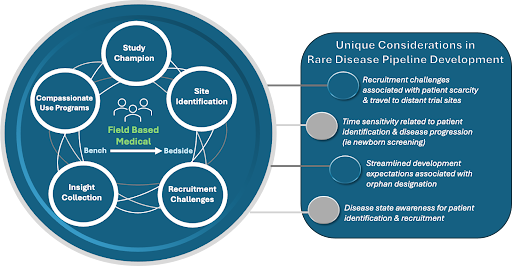
Figure 1.1 Field Medical Plays a Critical Role in Advancing Rare Disease Pipeline Activities. Field medical teams support pipeline development in a number of ways. Their responsibilities include site identification, supporting recruitment, collecting insights, and liaising contact and inquiries regarding compassionate use/managed access programs. Unique challenges of rare vs. non-rare pipeline activities include recruitment challenges due to patient scarcity, time sensitivity regarding disease onset/progression, streamlined development expectations, and disease state awareness initiatives to support recruitment and connecting patients to trial sites.
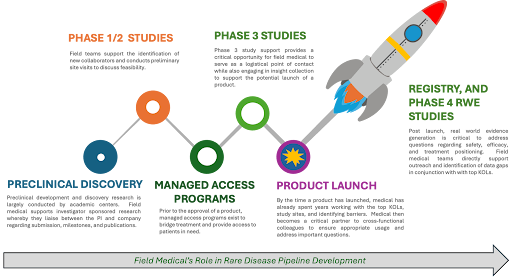
Figure 2.1 Field Medical Supports the Lifespan of Product Development. Clinical development involves FBM activity throughout all aspects of drug development. From the bench, preclinical work is supported as a liaison with Research & Development (R&D) collaborations and investigator-sponsored studies. Phase 1, 2, and 3 studies involve FBM efforts to support identification, recruitment, serving as a point of contact for logistical challenges, and potentially requests regarding MAP programs or compassionate use. Following launch, FBM activities move on to support Real World Evidence (RWE) activities and phase 4 collaborations.
References:
Swire-Thompson B, Lazer D. Public Health and Online Misinformation: Challenges and Recommendations. Annu Rev Public Health. 2020 Apr 2;41:433-451. doi: 10.1146/annurev-publhealth-040119-094127. Epub 2019 Dec 24. PMID: 31874069.
Sharma M, Yadav K, Yadav N, Ferdinand KC. 2017. Zika virus pandemic—analysis of Facebook as a social media health information platform. Am. J. Infect. Control 45(3):301–2
Sommariva S, Vamos C, Mantzarlis A, Đào LUL, Martinez Tyson D.2018. Spreading the (fake) news: exploring health messages on social media and the implications for health professionals using a case study. Am. J. Health Educ. 49(4):246–55
Vosoughi S, Roy D, Aral S. 2018.The spread of true and false news online. Science 359 (6380):1146–51
Addressing Misinformation About Medical Devices and Prescription Drugs: Questions and Answers; Draft Guidance for Industry; Availability; Agency Information Collection Activities; Proposed Collection; Comment Request https://www.regulations.gov/document/FDA-2014-D-0447-0020
About the authors:

Christopher N. Hansen, PhD, MBA
Chris is a translational scientist by training with extensive experience in the pharmaceutical industry and medical affairs. Chris completed his PhD and postdoctoral training at the Ohio State University and later completed his MBA with a specialization in healthcare leadership. He has spent over a decade in the industry working as an MSL, Medical Director, and MSL Director. He has supported 13 product/indication launches while leading HQ and field strategy development for field teams. Throughout this time, Chris has consistently looked for opportunities to mentor new and aspiring MSLs. He seeks to transform healthcare by inspiring field medical teams to deliver high-quality patient-focused engagement. When not at work, Chris is an avid runner and loves spending time with his wife and four children.

Jill Conner, PhD
Jill is an accomplished pharmaceutical industry professional with extensive experience in life cycle management, medical affairs, clinical operations, and project management. Jill is a published author, with numerous peer-reviewed articles, and she has also presented at various international conferences on topics ranging from patient centricity to immunogenicity assessment. She completed her MS in management and her PhD in International Health. Her work reflects a strong commitment to advancing medical science and improving patient care in the pharmaceutical industry. Currently serving as the Field Science Director for Rare Disease at Sanofi, she oversees scientific aspects of rare disease pipeline development in the field, bridging the gap between research and clinical application.

Angie Dale, PhD, MSA, MT(ASCP)SBB
Angie Dale started her career in laboratory medicine, focusing on Blood Banking and Transfusion Medicine. She managed a transfusion service in a large inner-city Level 1 Trauma Center and as an Assistant Professor at the University of Missouri-Kansas City School of Medicine, taught Pathology Residents. Dr. Dale then started what would be an over two-decades commitment to advancing treatments for underserved patient populations. She spent that time in Medical Affairs, first as a Medical Science Liaison, and then as a Senior Director Medical Affairs, focusing almost exclusively on Rare Disease. She launched multiple drugs for the treatment of hemophilia. Dr. Dale was pivotal in building Medical Affairs departments and shaping strategic initiatives in various companies, working cross-functionally with national and international partners.

Veronica Munoz, MD, PhD
Veronica Muñoz is a seasoned medical geneticist and global leader in the rare disease space, with over 17 years of experience focused on lysosomal storage disorders (LSDs). She began her career in Latin America as a clinical geneticist and clinical trial co-investigator before transitioning into industry roles in 2009. Since then, she has held diverse leadership positions across medical and commercial functions at Sanofi Genzyme, operating at country, regional, and global levels. Currently serving as Senior Medical Director for Pipeline, Dr. Muñoz is known for her dedication to patient-centric innovation, cross-functional team leadership, and significant contributions to clinical research, including numerous publications in the field of LSDs. Fluent in Portuguese, Spanish, and English, she brings a truly global perspective to her work.
Disclaimer: The ideas discussed in this manuscript belong to the authors and do not represent views or endorsements of their employer.
Have an opinion on this article? Send a message to the editor.